 The Luxembourg Regulatory Institute has published its annual report on key figures on the country’s railway sector for 2025;
Credit: Institut Luxembourgeois de Régulation – ILR
On Wednesday 11 November 2026, the Luxembourg Regulatory Institute (Institut Luxembourgeois de Régulation – ILR) published its annual report on key figures, bringing together all national statistical data for the country’s railway sector for 2025.
The report highlighted a slight decline in passenger transport activity, with 547.48 million passenger-km, and an increase in national freight transport, reaching 60.71 million tonne-km. Railway companies’ turnover from transport activities within the national territory has increased, as have investments in the national railway network.
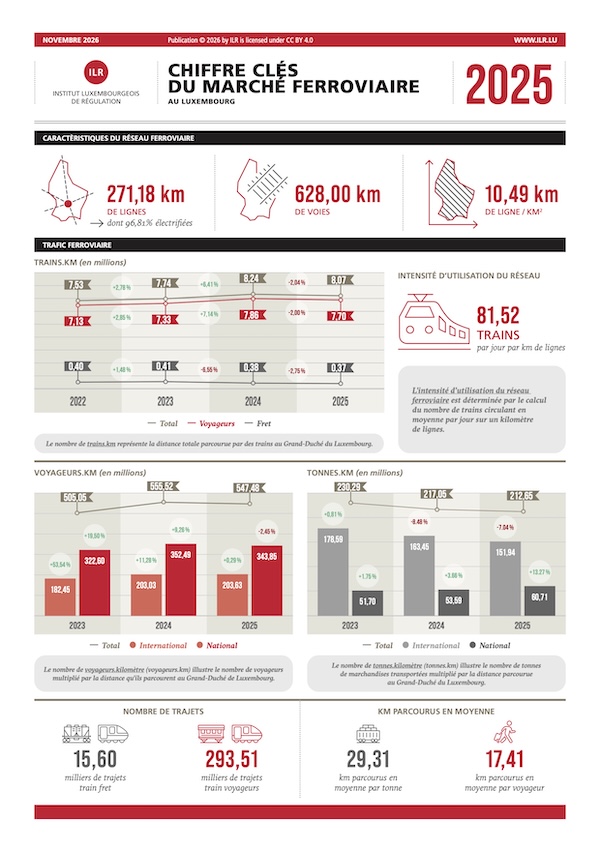
The key figures for the railway sector in 2025 show that the railway infrastructure remained stable, comprising 271 km of lines, 628 km of track and 68 passenger stations.
In 2025, trains travelled a total of 8.07 million train-km on the national network, representing a slight decrease of 2.04% compared with 2024. Passenger rail transport amounted to 7.70 million train-km (down 2.00% year on year), while freight transport amounted to 0.37 million train-km (down 2.75% year on year).
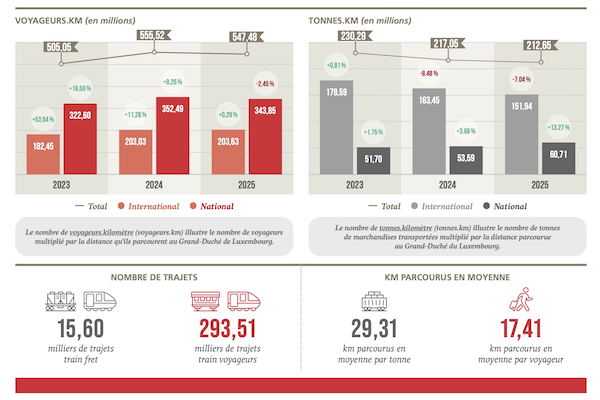
The report showed that after several years of growth, passenger transport recorded a slight decline in 2025, reaching 547.48 million passenger-km, marking a modest downturn since the post-Covid recovery (down 1.45% year on year). This development reflects a more pronounced decline in domestic passenger transport, which fell by 2.45% to 343.85 million passenger-km, while international passenger transport remained stable at 203.63 million passenger-km. This volume of transport corresponds to an average load of 71.12 passengers per passenger train-km travelled (up 0.57%).
Rail freight accounts for a significantly smaller share, representing less than 5% of total rail traffic in train-km on the national network. The volume of goods transported increased from 6.7 to 7.3 million tonnes, while freight transport volume decreased by 2.03% to reach 212.65 million tonne-km in 2025.
Domestic freight transport increased by 13.27% to 60.71 million tonne-km, reinforcing the upward trend observed since 2022. Conversely, international freight transport, covering traffic crossing at least one national border, declined by 7.04% year on year to 151.94 million tonne-km. Across all rail freight transport, the average load stood at 573.74 tonnes per train in 2025.
The mission of the Luxembourg Regulatory Institute (ILR) is to ensure and supervise, in the interests of consumers, the proper functioning of markets based on effective and sustainable competition, while guaranteeing a basic universal service.
The ILR is an independent authority responsible for regulating electronic communications networks and services, the transport and distribution of electricity and natural gas, postal services, rail transport and airport charges. The ILR also manages and coordinates radio frequencies.
Furthermore, the ILR serves as Luxembourg's single point of contact and competent authority for the security of networks and information systems, covering, in particular, the following sectors: energy, transport, healthcare, the supply and distribution of drinking water, digital infrastructure and digital services.
On the financial side, turnover from railway transport activities reached €366.35 million in 2025, an increase of 5.21%. Passenger transport generated turnover of €333.08 million in 2025, representing 90.92% of total turnover. Each train-km operated for passenger transport therefore generated average turnover of €43.30, while freight transport generated €89.07 per train-km.
Total track access charges levied by the railway infrastructure manager amounted to €24.82 million in 2025. The track access charge for passenger transport was €3.14 per train-km.
Investments in the national railway network amounted to €327.06 million in 2025, an increase of 15.07% compared with 2024.
The report complements the range of information provided by the ILR to interested parties. In addition to this report, the ILR offers other tools, including interactive tables, an infographic providing detailed explanations of the indicators and units, and Open Data. These resources aim to present a comprehensive and impartial overview of information on Luxembourg's railway sector in various formats.
Further information can be found at ILR – Publications and infographics.