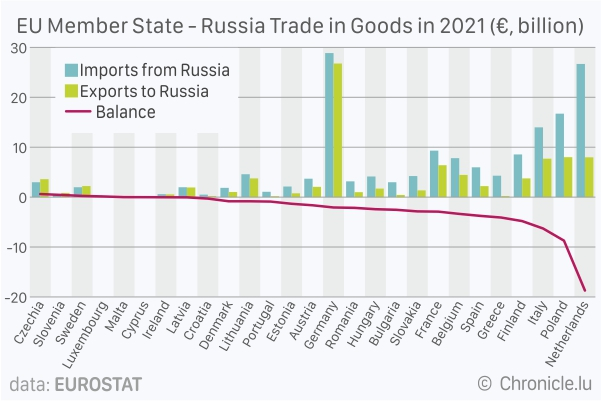
Data extracted from European statistics agency Eurostat have shown that the European Union (EU) imported €158 billion worth of goods from Russia and exported goods worth around €89 billion in 2021, resulting in a trade surplus of €69 billion in favour of Russia.
Historically, Russia has recorded a trade surplus with the EU, but following the ongoing Russia-Ukraine conflict and economic sanctions from the EU targeting the Russian economy, the trade surplus is expected to decrease in 2022.
In terms of individual Member States, 23 out of 27 EU countries had a trade deficit with Russia last year. Only four Member States reported a trade surplus with Russia in 2021: Czech Republic (€615 million), Slovenia (€436 million), Sweden (€244 million) and Luxembourg (€139 million).
In 2021, Germany was the biggest trade partner of Russia from the EU in terms of value, both for imports (€29 billion) and for exports (€27 billion), whilst the Netherlands recorded the highest deficit (€19 billion).
In the past 20 years, for which detailed data are available, the highest amount of goods imported by the EU from Russia was in 2012 (€204 billion) and the lowest was in 2002 (€61 billion), whilst the highest EU exports to Russia were in 2012 (€118 billion) and lowest were in 2002 (€33 billion), showing that the overall trade between the EU and Russia has decreased since 2012. In terms of a yearly trade deficit with Russia, the highest was recorded in 2011 (€89 billion) and the lowest in 2020 (€15 billion). The year 2020 was exceptional in terms of COVID-19 related health measures and the only time since 2005 that the EU has a trade deficit with Russia of less than €40 billion.
In terms of the share of all trade partners for EU exports and imports in 2021, trade with Russia represented 4.1% and 7.5%, respectively. In turn, Russia was the fifth largest EU export destination and the third largest partner for EU imports.
In terms of the type of goods traded, 88% of EU exports to Russia in 2021 were manufactured goods, which included machinery and vehicles (44%), chemicals (23%) and other manufactured goods (22%), and the remaining 12% included food and drink, raw materials and energy. In contrast, EU imports from Russia in 2021 were highest for energy (62%) followed by other manufactured goods (13%) and other goods (13%).
The majority of the €99 billion of energy imported (62% share of all imports) by the EU from Russia in 2021 represented crude oil (€48.5 billion), potroleum products other than oil (€22.4 billion) and natural gas (€17.8 billion).