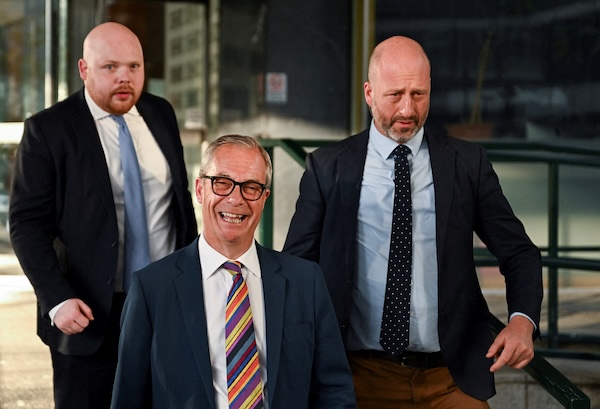
 Britain's Reform UK leader Nigel Farage reacts as he leaves Millbank Tower following the results of the local elections, in London, Britain, 8 May 2026;
Credit: Reuters/Chris J Ratcliffe
Britain's Reform UK leader Nigel Farage reacts as he leaves Millbank Tower following the results of the local elections, in London, Britain, 8 May 2026;
Credit: Reuters/Chris J Ratcliffe
LONDON, (Reuters) - Keir Starmer's Labour Party suffered heavy early losses in local elections on Friday 8 May 2026, showing the depth of voter anger with the British prime minister and increasing doubts about his future just two years after a landslide victory in a national vote.
Labour haemorrhaged support in areas reporting early results, including in traditional strongholds in former industrial regions of the Midlands and northern England, along with some parts of London.
The main beneficiary was the populist Reform UK party of Brexit campaigner Nigel Farage, which gained more than 300 council seats in England and could form the main opposition in Scotland and Wales to the pro-independence Scottish National Party and Plaid Cymru.
"The picture has been pretty much as bad as anyone expected for Labour or worse," said John Curtice, Britain's most respected pollster.
The elections for 136 local councils in England, alongside the devolved parliaments in Scotland and Wales, represent the most significant test of public opinion before the next general election due in 2029.
Some Labour lawmakers said that if the party performs poorly in Scotland, loses power in Wales and fails to hold many of the roughly 2,500 council seats it is defending in England, then Starmer will face renewed pressure to quit or at least set out a timetable for his departure.
However, Starmer's allies quickly backed the prime minister, saying it was not the time to move against him.
Defence Secretary John Healey said the last thing voters wanted was "the potential chaos of a leadership election".
"I think he can still deliver, he can still turn it round," Healey told Times Radio.
Insurgent parties fracture two-party system
The early results showed the continued fracturing of Britain's traditional two-party system into a multi-party democracy in what analysts say represents one of the biggest transformations in British politics in the last century.
The once-dominant Labour and Conservative parties lost votes to Reform and, at the other end of the political spectrum, to the Green Party, while nationalist parties were expected to win the elections in Scotland and Wales.
Farage said the results so far represented a "historic change in British politics".
Labour was wiped out in some of the most closely watched early contests.
The party lost control of the council of Tameside in Greater Manchester for the first time in almost 50 years after Reform picked up all fourteen seats Labour was defending.
In nearby Wigan, a former mining community Labour had controlled for more than 50 years, the party also lost every one of the 20 seats it was defending to Reform. In Salford, Labour held only three of the sixteen seats it defended.
The results were "soul-destroying", said Rebecca Long-Bailey, a Labour MP for Salford.
While incumbent governments often struggle in mid-term elections, pollsters forecast that Labour could lose the most council seats in local elections since former Conservative Prime Minister John Major lost more than 2,000 in 1995, when his government was mired in corruption scandals.
Reform UK added 335 council seats in England in the early results. Labour lost 247 seats while the Conservatives were down 127 seats.
Most of the results, including those in the Scottish and Welsh elections, are due to be declared later on Friday.
U-turns and scandals erode Starmer's authority
Starmer, a former lawyer, won the 2024 election with one of the largest parliamentary majorities in modern British history on the promise that he would bring stability after years of political chaos.
However, his time in office has been marked by policy U-turns, a rotating cast of advisers and the appointment of Peter Mandelson as Britain's ambassador to the United States (US). Mandelson was later dismissed nine months into the role over his links to the late convicted US sex offender Jeffrey Epstein.
Starmer insists he will lead Labour into the next election and the party has never successfully removed an incumbent prime minister in its 125-year history.
The prime minister is also helped by the fact that two frontrunners to succeed him, Greater Manchester Mayor Andy Burnham and former Deputy Prime Minister Angela Rayner, are not yet in positions to mount leadership bids, while other rivals appear unwilling to move against him for now.
Energy Secretary Ed Miliband's team denied on Thursday 7 May 2026 a report in The Times newspaper that he had advised Starmer to consider setting out a timetable for his departure.