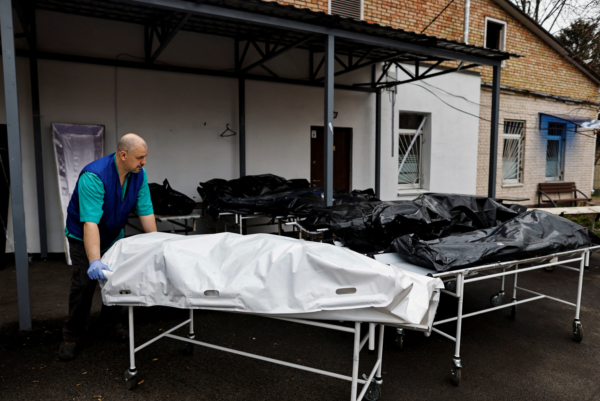
 Bodies waiting to be identified by their families, are seen outside the morgue amid Russia's invasion of Ukraine, in Bucha, Kyiv region, Ukraine 20 April 2022;
Credit: Zohra Bensemra / Reuters
Bodies waiting to be identified by their families, are seen outside the morgue amid Russia's invasion of Ukraine, in Bucha, Kyiv region, Ukraine 20 April 2022;
Credit: Zohra Bensemra / Reuters
VILNIUS (Reuters) - Lawmakers in Latvia and Estonia voted unanimously on Thursday 21 April 2022 to declare killings of civilians in areas of Ukraine occupied by Russian forces to be acts of genocide, according to statements posted on the two parliaments' sites.
Russian troops that pulled out of Ukraine's north a few weeks after Moscow's 24 February 2022 invasion left behind towns littered with bodies of civilians - evidence of what US President Joe Biden said last week amounts to genocide.
The Kremlin said it categorically disagreed with that position and accused Washington of hypocrisy. Moscow has denied targeting civilians in the war, saying, without evidence, that the incidents in question were faked to tarnish its military.
Under international law, genocide is an intent to destroy - in whole or in part - a national, ethnic, racial or religious group. The ultimate war crime has a strict legal definition and has rarely been proven in court since it was cemented in humanitarian law after the Nazi Holocaust.
In its statement, the Latvian parliament cited "evidence of mass brutal crimes committed by the army of the Russian Federation, including the murder, torture, sexual abuse and desecration of Ukrainian civilians, including women and children, in Bucha, Irpin, Mariupol and elsewhere".
Estonia's parliament cited "murders, enforced disappearances, deportations, imprisonment, torture, rape, and desecration of corpses".
On 28 February 2022, four days into the invasion, International Criminal Court chief prosecutor Karim Khan said he had opened a formal investigation into alleged war crimes and crimes against humanity in Ukraine. A month later he urged countries to back his investigation and on 14 April 2022 said he would keep trying to get Russia to engage with the inquiry.
An initial report by a mission of experts set up by the Organization for Security and Cooperation in Europe (OSCE), the continent's top security and rights watchdog, documents a "catalogue of inhumanity" by Russian troops in Ukraine, according to the US ambassador to the OSCE.
This included, Ambassador Michael Carpenter said, evidence of "direct targeting of civilians, attacks on medical facilities, rape, executions, looting and forced deportation of civilians to Russia".
French President Emmanuel Macron said that using the word "genocide" would amount to verbal escalation that would complicate his efforts to bring peace to Ukraine.
Moscow says the aim of its "special military operation" in Ukraine is to disarm its neighbour, defeat nationalists and protect separatists in the southeast. Kyiv and its Western allies reject that as a false pretext for an illegal war of aggression.