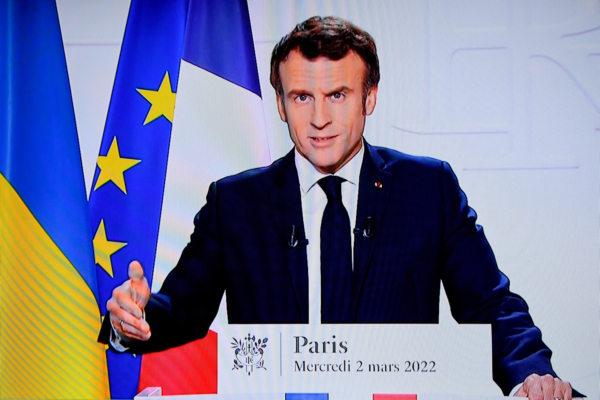
 French President Emmanuel Macron appears on a screen as he delivers a speech on the Russian invasion of Ukraine, in Paris, France 2 March 2022;
Credit: Piroschka van de Wouw / Reuters
French President Emmanuel Macron appears on a screen as he delivers a speech on the Russian invasion of Ukraine, in Paris, France 2 March 2022;
Credit: Piroschka van de Wouw / Reuters
PARIS (Reuters) - French President Emmanuel Macron said on Thursday 3 February 2022 that he would run for a second term in April's elections, seeking a mandate to steer the Euro zone's second-largest economy through the fallout of Russia's invasion of Ukraine and the COVID-19 pandemic.
President Macron announced his bid in a letter published by several regional newspapers.
If he succeeds, he would be the first French leader for two decades to win a second term in office.
"We have not achieved everything we set out to do. There are choices that, with the experience I have gained from you, I would probably make differently," President Macron said in the letter, listing the different crises he had to face over the past five years, including militant attacks, COVID-19, riots and war.
He defended his record, pointing to unemployment at a 15-year low. "I am running to defend our values that the world's disorders are threatening," he added.
Without giving a detailed manifesto, President Macron said he would continue to cut taxes and push for the French to work more, suggesting a return of an abandoned pension reform. He also hinted at a reform of the education system, saying teachers should be freer and paid better.
President Macron enters the presidential race just a month or so before the election's first round on April 10. Opinion polls project that he is favourite to win a contest that sees multiple challengers on the right and left fragmenting the vote.
The Ukraine war has already upended the campaign, complicating President Macron's entry into the race and leaving two far-right contenders who had so far performed strongly in polls to justify their hitherto pro-Russia, pro-Putin stance.
FOREIGN POLICY VS IDENTITY
With President Macron at the forefront of European efforts to secure a ceasefire and a peaceful resolution to the conflict, a campaign with fewer rallies by the incumbent and an unusual focus on foreign policy lies ahead.
President Macron, who has spoken on the phone with Putin eleven times this year, has said he would continue as the war rages on and acknowledged in the letter he will not be able to campaign as he would have liked because of the war.
That may not hurt his chances. Voter surveys have shown a bounce in support for Macron as far-right leaders Marine Le Pen and Eric Zemmour revise their views on relations with Moscow and amid an outpouring of sympathy for Ukrainian refugees.
But in a sign identity politics could rear its head again in the final stretch of the campaign, Mr Zemmour, a former TV commentator known for his inflammatory anti-immigrant views, said in a reply to President Macron's letter that the leader was hostile to the values of Mr Zemmour and his supporters.
"Emmanuel Macron spent the past five years fighting the France of our childhood. He hates our identity. We cherish it and want to transmit it to our children," Mr Zemmour said.
Centre-right conservative Valerie Pecresse, who is in third place in the polls but would be his toughest opponent in a runoff, said President Macron was running to do the reforms he had failed to do over the past five years. "You need courage to reform. I have it," she said.
President Macron became France's youngest leader since Napoleon five years ago, pitching himself as a political outsider who would break the old left-right dichotomy, make France more investor-friendly and make the EU stronger.
He cut taxes for big business and the wealthy, loosened labour laws and marketed France Inc. as a start-up nation, but anti-government "yellow vest" protests and then the COVID-19 pandemic forced him to slow his reform plans.