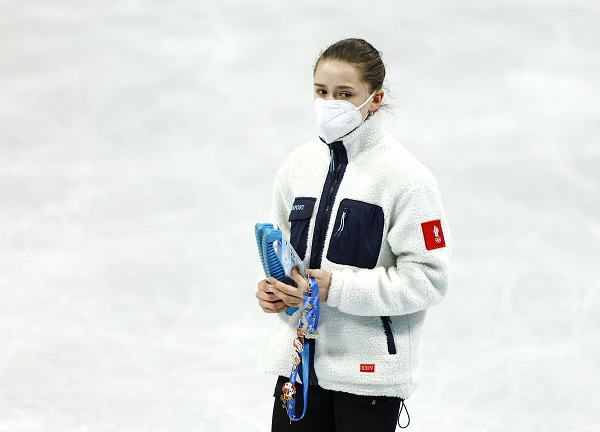
 Kamila Valieva of the Russian Olympic Committee during training at Training Rink Capital Indoor Stadium, Beijing, China on 11 February 2022;
Credit: Reuters / Evgenia Novozhenina
Kamila Valieva of the Russian Olympic Committee during training at Training Rink Capital Indoor Stadium, Beijing, China on 11 February 2022;
Credit: Reuters / Evgenia Novozhenina
BEIJING (Reuters) - On Saturday 12 February 2022, Olympic officials said they would welcome an anti-doping investigation into the Russian doctors, coaches and family members in the entourage of 15-year-old figure skater Kamila Valieva.
Kamila Valieva's future at the Beijing Olympics hangs in the balance after the stunning revelation she had tested positive for a banned substance before winning the team event on Monday 7 February 2022, but that the positive drug test report took more than six weeks to be made public.
She is one of the youngest athletes ever to test positive for doping at the Olympics.
Fans of figure skating, athletes and anti-doping advocates have expressed outrage over a teenager being at the centre of a doping controversy with a positive test for a drug used to treat heart conditions like angina.
Many have questioned the role of the adults around the teenage skater and the continuing scourge of Russian doping in international sports.
The Kremlin, alreading facing Western diplomatic wrath over a troop buildup near Ukraine, called Kamila Valieva's case a "misunderstanding".
Rachael Denhollander, the first woman to publicly accuse former USA Gymnastics doctor Larry Nassar of sexual abuse, told Reuters that the Russian prodigy's failed drug test was a reminder of how vulnerable young athletes remain.
"A child does not make a choice to take those kinds of medications unless they're given to her by somebody who's in authority", Ms Denhollander told Reuters. "What we're really seeing is the incredible damage that has come yet again to a child who has been under the control of adults who value her, not for who she is but for what she can produce for them".
On Saturday, spokesman Mark Adams said the International Olympic Committee (IOC) would welcome an investigation into the entourage surrounding Kamila Valieva and other young athletes by anti-doping authorities.
"Entourage has been overlooked in the past", Mr Adams said.
Kamila Valieva is due to compete again on Tuesday 15 February 2022 in the women's individual event. By then, the Court of Arbitration for Sport (CAS) should have ruled on her case from a closed boardroom on the second floor of a Beijing hotel.
The delay in Ms Valieva receiving her positive drug test result loomed large over the legal case on Saturday .
She was suspended by the Russian anti-doping body after the positive test report on Tuesday 8 February 2022, the day after the gold medal victory. The suspension was then lifted on Wednesday 9 February 2022 after she appealed, allowing her to continue to compete.
More than six weeks went by between Kamila Valieva's sample being taken on 25 December 2021 and 8 February 2022 when she was notified by a laboratory in Stockholm, Sweden that she had tested positive for the banned heart medication trimetazidine. The Stockholm lab is accredited by the World Anti-Doping Agency (WADA).
The Russian Olympic Committee (ROC) and the Russian Anti-Doping Association have questioned the timeline.
On Saturday, the IOC said the delay was a question for WADA.
"I can't speak directly about the delay", Mark Adams said. "It was a WADA-sanctioned lab in Stockholm so that is a question that should be directed to WADA".
WADA could not be immediately contacted by Reuters.
The IOC and WADA have asked the CAS to reinstate Kamila Valieva's suspension.
The IOC said on Saturday that the hearing date would not be made public.