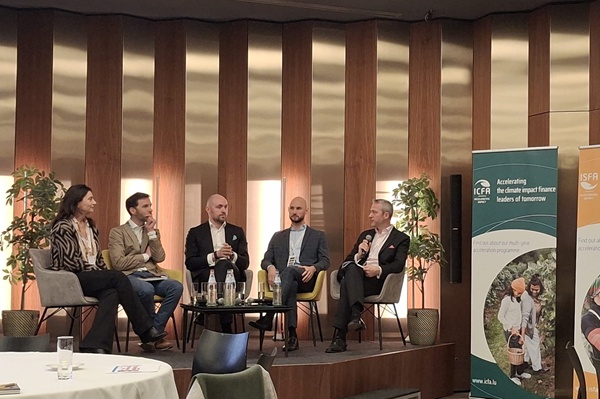
 (L-R) Teresa Guardans, Oryx Impact; Arnaud Gillin, Innpact; Raphael Betti, EY Luxembourg; Lennart Duschinger, Luxembourg's Ministry of Finance; Stephan Peters, Accelerating Impact;
Credit: Chronicle.lu
(L-R) Teresa Guardans, Oryx Impact; Arnaud Gillin, Innpact; Raphael Betti, EY Luxembourg; Lennart Duschinger, Luxembourg's Ministry of Finance; Stephan Peters, Accelerating Impact;
Credit: Chronicle.lu
This year's edition of the Impact Finance Forum, organised by Accelerating Impact (International Climate Finance Accelerator - ICFA - and International Social Finance Accelerator - ISFA), took place in Luxembourg on Thursday 5 and Friday 6 February 2026.
The forum opened with a networking event at the House of Startups in Luxembourg-Bonnevoie on Thursday evening, followed by an Ecosystem Day hosted at EY in Luxembourg-Kirchberg on Friday.
The main conference programme explored topics including biodiversity finance, applying a child lens in impact investing, using artificial intelligence (AI) for good and the role of the Sustainable Development Goals (SDGs) in private finance.
Following registration and breakfast, the opening session on Friday morning provided an assessment of the current impact finance landscape, highlighting structural tensions and practical bottlenecks faced by emerging impact fund managers. The session also emphasised a shift away from narrative-driven dialogue to implementation-focused exchange.
In his welcome speech, Stephan Peters, CEO of Accelerating Impact, presented Accelerating Impact, a public-private partnership mobilising capital for measurable climate and social impact. Since its creation in 2018, the organisation has received 353 fund proposals, supported 47 fund managers across ten cohorts and helped launch eighteen investment vehicles (managing almost €500 million in assets under management). Speaking about the aim of the forum, he said: "Let's unite to accelerate positive impact for society and our planet," encouraging collaboration within Luxembourg's impact finance ecosystem and the open sharing of experiences, lessons learned and best practices during the forum.
A live audience survey highlighted fundraising as the sector's main challenge, followed by aligning expectations and measuring impact. Participants also identified greater limited partner (LP) participation and enhanced collaboration as key priorities for the coming years.
Matteo Menegatti, Private Equity and Alternative Investment Funds Partner at EY Luxembourg, spoke about the growth of impact investing in Luxembourg, as an investment fund hub. He said this "excellence" was based on "a strong culture of knowledge building and knowledge sharing", of which this forum was a good example.
A panel discussion on the state of impact finance, moderated by Stephan Peters, brought together representatives from EY, Innpact, Luxembourg's Ministry of Finance and Oryx Impact. Speakers noted that geopolitical tensions, tighter public budgets and regulatory uncertainty had created a more challenging environment for impact investing.
Raphael Betti, Partner, Climate Change and Sustainability Services Leader at EY Luxembourg, pointed to the impact of political uncertainty and regulatory complexity on the sector, highlighting fundraising challenges and warning against underestimating the impact of regulation. He also stressed the need for a strong ecosystem in which different players communicate with each other.
Arnaud Gillin, Partner and co-founder of Innpact, said that the next two to three years may remain challenging from a fundraising perspective and mentioned recent geopolitical and regulatory pressures. However, he welcomed the sector's growing self-reflection on whether it is taking the right approach. He too stressed the need for greater collaboration. "We need to speak the right language and present it without changing our DNA," he added, noting that many actors are working towards the same goals but need to communicate this more clearly.
Lennart Duschinger, Head of Sustainable Finance at Luxembourg's Ministry of Finance, pointed to shifting public sector priorities worldwide, notably increasing defence spending. He referred to a global "polycrisis" marked by competing priorities and noted that framing sustainability in terms of risk and resilience often resonates more strongly. He also underlined the importance of integrating impact finance into broader economic and financial systems and emphasised the need for public-private collaboration. Lennart later referred to both measurement and regulatory fatigue, reiterating the importance of doubling down on a systemic approach.
Teresa Guardans, co-founder, Investment Consultant and Impact Investor at Oryx Impact, highlighted challenges in accessing capital for smaller and emerging fund managers, particularly in Africa. She described the reduction in international development funding as a "wake-up call", underlining the need to "break the status quo of dependency" and to identify new types of capital. She also emphasised the importance of collaboration across the ecosystem.
The session concluded with a call for greater inclusiveness, improved communication and stronger cooperation. The speakers also highlighted the importance of education, diversity and resilience, the need to involve all stakeholders and the value of events such as this forum to exchange views and experiences. As Lennart Duschinger noted, while the current environment remains challenging, the tools and infrastructure for impact finance already exist and now need to be scaled.
The event continued after the coffee break with parallel sessions and concluded in the early evening.
The forum featured a variety of interactive formats, including World Café discussions, simulation games, debates, fireside chats and hands-on workshops, with a strong focus on peer learning and collaborative idea generation.