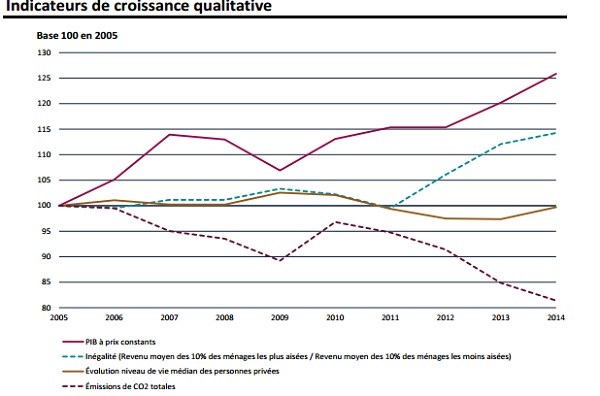
STATEC’s recent analysis has shown that between 2009 and 2013, the rate of poverty among unqualified workers in Luxembourg has increased and the standard of health as decreased, despite economic growth.
In spite of economic growth, which is certainly favourable for development, living conditions for individuals has not improved. People aged between 50 and 64 years with a secondary or higher education are the most negatively affected.
Therefore, in order to evaluate the qualitative growth of an economy, it is important to use other indicators in addition to GDP, which only measures the production of goods and services. Such indicators include those which take into account the protection of the environment, the sharing of income and patrimony, quality of life and well-being.
On a positive note, the growth of GDP by more than 25% between 2005 and 2015 was coupled with a reduction of carbon dioxide emissions, which have dropped by 19% compared to 2005.
However, there were also less positive findings, such as the fact that whilst the GDP increased significantly, working conditions deteriorated. Between 2009 and 2013, the number of long-term unemployed people increased, with the most affected age group being those between 35 and 49 years old and those with a primary or tertiary level of education. Moreover, the number of people working more than 50 hours per week increased from 3.6% in 2009 to 6.5% in 2013. This also shows a deterioration in work life balance.
As is the case in most developed countries, Luxembourg’s economic growth over the years has led to increased wage inequalities, especially since 2009. Whilst income continues to progress, this is for the most part due to inflation.
Over the past years, STATEC has been developing new tools which allow the simultaneous simulation of changes in the economy, population and energy consumption. Such tools allow the long-term analysis of the components and interactions of qualitative growth.
Photo by STATEC.