 Credit: © MECB/Emmanuel Claude
On Wednesday 23 and Thursday 24 September 2026, Leena Ylä-Mononen, Executive Director of the European Environment Agency (EEA), paid a working visit to Luxembourg at the invitation of Luxembourg’s Minister for the Environment, Climate and Biodiversity, Serge Wilmes.
According to Luxembourg’s Ministry of the Environment, Climate and Biodiversity, this marked the EEA’s first official visit to Luxembourg and provided an opportunity to strengthen exchanges between Luxembourg, the Agency and the European Environment Information and Observation Network (Eionet).
During the visit, Minister Wilmes and Leena Ylä-Mononen discussed the main environmental challenges facing Europe, particularly climate change, the preservation of biodiversity and the role of scientific knowledge in the development of public policies. They also discussed Luxembourg’s contribution to the EEA’s work and prospects for future cooperation.
Minister Wilmes stressed that “environmental and climate challenges go beyond national borders” and that “only European cooperation based on the sharing of knowledge, experience and expertise will make it possible to develop robust and sustainable solutions for future generations.”
On Wednesday 23 September 2026, the EEA delegation met several European institutional partners based in Luxembourg, including the European Investment Bank (EIB) and Eurostat, as well as Luxembourg representatives involved in the activities of the EEA and the Eionet network.
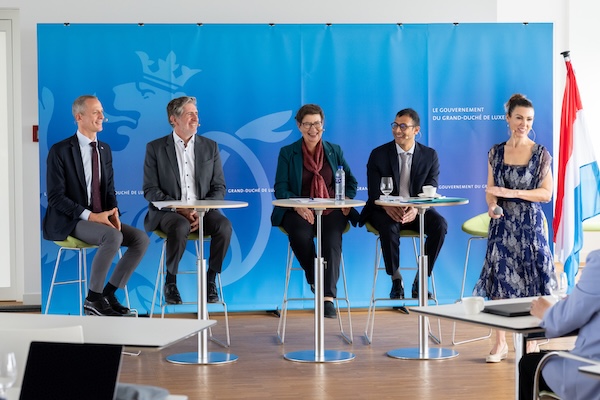
The following day, Minister Wilmes opened a conference devoted to the use of environmental knowledge in public policies. National stakeholders from public administrations, research, civil society and other relevant sectors were also invited. The discussions highlighted the importance of reliable data and solid scientific expertise in supporting the ecological transition. Leena Ylä-Mononen presented the EEA’s missions and the activities of the Eionet network.
Particular emphasis was placed on the flagship report Europe’s Environment 2025, the current edition of which includes, for the first time, a country profile devoted to Luxembourg. This profile highlights the progress made by the country in reducing greenhouse gas emissions, developing renewable energy, sustainable mobility and the circular economy. It also highlights the persistent challenges relating particularly to transport, biodiversity and the quality of water resources.
The ministry added that the discussions confirmed the importance of close cooperation between national and European stakeholders in order to strengthen science-based decision-making and effectively address the environmental challenges of tomorrow.