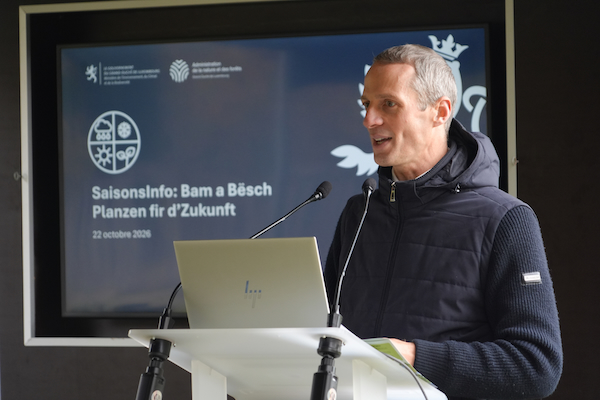
 Serge Wilmes, Luxembourg Minister of the Environment, Climate and Biodiversity;
Credit: Ministry of the Environment, Climate and Biodiversity
On Thursday 22 October 2026, Luxembourg’s Ministry of the Environment, Climate and Biodiversity and the Nature and Forestry Administration held a press conference on the current state of Luxembourg’s forests and the efforts and measures being implemented to strengthen their resilience.
The press conference, held under the banner “Bam a Bësch - Planzen fir d‘Zukunft” (“Trees and Forests – Planting for the Future”), took place in Potaschberg, following a summer marked by a prolonged period of drought and with the tree-planting season approaching.
Forests under pressure
The ministry noted that heatwaves and droughts observed in recent years continue to place significant pressure on forest ecosystems.
Beyond their ecological impacts, these conditions also affect safety in forests. Weakened or damaged trees can pose an increased risk of falling branches or trees.
In this context, the speakers reiterated the safety guidelines for forest users:
⁃ Remain vigilant when walking or taking part in activities in forests.
⁃ Avoid forests during and after storms or heavy rainfall.
⁃ Prefer open areas and remain on marked paths.
⁃ Respect temporary closures and safety instructions.
⁃ Avoid any activity that could cause a fire to start.
Preparing today for the forests of tomorrow
The ministry emphasised that promoting diverse forest stands is a key measure for supporting the adaptive capacity of tomorrow’s forests. By encouraging a variety of tree species within the same forest, the risk that a particular event, disease or pest will affect the entire stand is reduced. Thus, even if certain species are weakened, others can continue to grow, maintaining forest cover and its many ecological functions.
To strengthen forest resilience, the choice of tree species must be accompanied by particular attention to their genetic origin and suitability for local conditions, especially soil characteristics and the geology of the sites concerned. In this respect, using forest reproductive material derived from trees whose previous generations have already grown in our regions is particularly important. This helps promote better adaptation to local environmental conditions while enabling local needs to be met more quickly and reducing dependence on international producers.
In this context, the example of the wild service tree (Sorbus torminalis), a species native to our regions since ancient times, and the role of seed orchards managed by the Nature and Forestry Administration (ANF) were presented at the press conference.
Trees: An investment in the climate and quality of life
Beyond forest areas, trees play an essential role in helping our towns and villages adapt to the impacts of climate change. They help reduce urban heat islands, improve air quality, promote water infiltration into the soil, store carbon and provide valuable habitats for numerous animal and plant species.
With the planting season approaching, the ministry emphasised the importance of continuing and intensifying tree-planting efforts to strengthen the country’s tree stock over the long term.
Launch of the “Planting for the Future” campaign
As part of the European Union’s biodiversity strategy for 2030, the EU has set itself the target of planting an additional three billion trees by the end of the decade.
To contribute to this collective effort, Luxembourg is launching a national campaign, “Planting for the Future” (Planzen fir d’Zukunft), committing to planting an additional 1.7 million trees by 2030. This target is included in the third National Nature Conservation Plan (PNPN3), the National Climate Change Adaptation Strategy and the forthcoming National Nature Restoration Plan.
This commitment is based on a fundamental principle: “The right tree, in the right place, for the right reason.”Only plantings suited to local conditions, carried out voluntarily and going beyond legally required compensatory measures can be counted towards the European Tree Pledge.
Citizens, municipalities, businesses and associations are invited to contribute to this shared goal by registering their tree plantings through the European MapMyTree platform.
Practical tools for taking action
With the tree-planting season approaching, additional initiatives were presented, including the Nature Pact’s “Bamchallenge” and the call for projects entitled “More Nature in Our Towns and Villages” (Méi Natur an eise Stied an Dierfer).
“Naturpakt Bamchallenge”
The Nature Pact is a key instrument for supporting municipalities in their efforts to promote biodiversity and increase green spaces. Launched under the Nature Pact, the “Naturpakt Bamchallenge” competition invites municipalities to increase tree planting up to Nature Pact Day in June 2027 and actively contribute to the national target of planting an additional 1.7 million trees.
“More Nature in Our Towns and Villages”
This call for projects launched by the Ministry supports, in particular, projects to remove artificial surfaces and introduce vegetation in public squares, school playgrounds, car parks and play areas, thereby promoting the creation of green infrastructure at the heart of local communities.
By increasing the presence of nature and trees in urban areas, these improvements help reduce the effects of heatwaves, strengthen local biodiversity, improve rainwater management and enhance citizens’ well-being. Selected projects may receive financial support covering up to 90% of eligible costs, up to a maximum of €500,000, enabling municipalities to play a leading role in the transition towards towns and villages that are more resilient to climate challenges.
A new call for projects under “More Nature in Our Towns and Villages” (Méi Natur an eise Stied an Dierfer) will be launched in December.
“By investing in trees and nature, we are investing in our future. All these initiatives aim to strengthen Luxembourg’s resilience, protect its citizens and biodiversity, and ensure a better quality of life for future generations,” said Serge Wilmes, Minister of the Environment, Climate and Biodiversity.