 Credit: Transition Minett / ACTE Interreg project
On Wednesday 28 January 2026, the Alzette Belval cross-border region officially launched the "Presque zéro déchet" (almost zero waste) family challenge.
In total, fifteen families have volunteered to embark on this six-month challenge, aiming to adopt more eco-friendly and responsible habits at home. They will receive free support through a series of practical and educational workshops: DIY, preserving, sewing, repairs, composting, sharing best practices, etc.
The challenge is being carried out within the framework of the ACTE (Avec les Citoyens pour la Transition Ecologique) cross-border Interreg project, in collaboration with the GECT Alzette Belval, the municipality of Sanem and various project partners. It aims to demonstrate how changing family habits can have a tangible and inspiring impact for everyone.
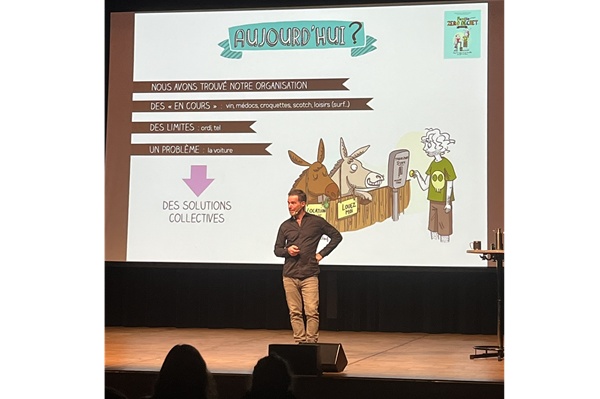
The launch event took place at Artikuss in Sanem and featured an introduction by Sanem Alderman Steve Gierenz. Subsequently, Jérémie Pichon, co-founder of the challenge and co-author of the book Famille Presque Zéro Déchet : Ze Guide (Almost Zero Waste Family: The Guide), humorously and sincerely shared his family's experience, as illustrated by "Bob le bocal" (Bob the Jar), which contains a year's worth of waste produced by his family. He highlighted the major environmental and health challenges linked to the global accumulation of waste, while presenting concrete solutions for everyday action and inspiring families, and emphasised: "Reducing waste is at the heart of the ecological transition. And when the whole family gets involved, the impact becomes real."
He noted: "The ocean receives approximately 200 kg of waste per second. The seventh continent of plastic is now the size of a third of Europe or six times the size of France", also raising concerns about the direct health consequences: "All this waste ends up on our plates. If nothing changes, by 2040 there will be more plastic than fish in the oceans."
During his presentation, Jérémie Pichon debunked several misconceptions, particularly regarding recycling: "Recycling is largely a myth: the majority of plastic waste is not recycled but incinerated." He reminded the audience that our current economy is linear, not circular, and that overconsumption, the engine of economic growth, is also a massive source of waste: "We pay for packaging in our supermarkets... only to throw it away." Faced with this reality, he shared concrete and accessible solutions, for example: buying in bulk, short supply chains, secondhand goods, homemade products, repairs, composting, swapping, and renting or borrowing instead of buying. "Buy less and better, for ourselves and for our planet," he said.
Jérémie Pichon also emphasised the importance of support from local authorities and encouraged the participating families, saying: "Thank you to the families who are taking action today for our future. They are the ones who will inspire us."
After the conference, the families left with a free starter kit to begin their zero-waste adventure.
According to the organisers, this family challenge is "first and foremost a collective and inspiring adventure, demonstrating that waste reduction brings environmental, economic and health benefits, while strengthening social bonds and intergenerational transmission." They added: "Within the framework of the ACTE project, citizens are supported in carrying out projects that facilitate this change in habits. From creating reuse centers to promoting local food, the solutions are there for everyone!"
The ACTE project, conducted in the Alzette Belval region, brings together several Luxembourgish and French partners (local authorities, associations and grassroots actors) with the aim of fostering citizen engagement and supporting local initiatives that promote ecology, solidarity and "living together".