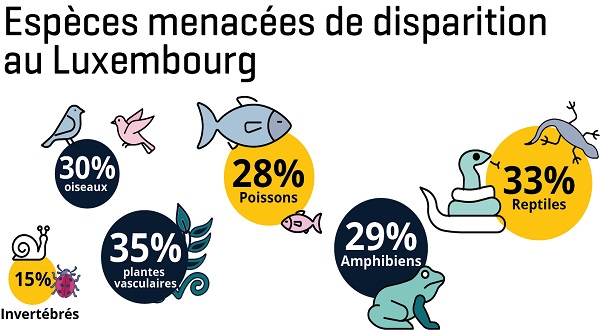
 Credit: STATEC
On Friday 12 December 2025, Luxembourg's Minister of the Environment, Climate and Biodiversity, Serge Wilmes, together with STATEC Director Tom Haas and Dr Olivier Thunus, presented the first edition of the publication La Biodiversité en chiffres (Biodiversity in Figures), one of the key actions of the third national plan for nature protection (PNPN3).
The report is based on 25 selected indicators and aims to provide a rigorous overview of biodiversity in Luxembourg, highlighting the current state of habitats, species and conservation efforts.
Produced through close collaboration between numerous stakeholders, the publication draws on objective and scientifically robust data provided by the Nature and Forest Agency, the Water Management Agency, the Luxembourg Institute of Science and Technology (LIST), the National Museum of Natural History (natur musée) and the ornithological centre of natur&ëmwelt asbl.
Structured around three main chapters, the report first addresses habitat diversity and health, focusing on forests, open habitats and aquatic zones. It then analyses species diversity and status, paying particular attention to threatened species and emblematic groups such as birds and butterflies. The final chapter presents conservation initiatives implemented in Luxembourg, including the creation of protected areas and the use of specific financial instruments. Additional indicators are being developed for future editions of the publication.
"This report provides a clear overview of the current state of biodiversity in Luxembourg and the commitments made to its preservation. It is an essential tool for monitoring changes in habitats and species and for guiding future actions," said Minister Wilmes.
The stated goal of the publication is to offer a precise, objective and documented view of the current state of nature, to highlight protection, conservation and restoration efforts, and to inform the public annually about the current state of biodiversity and the progress made.
Among the figures highlighted in the report:
- in 2021, natural and semi-natural areas covered 65.1% of Luxembourg's territory, a decrease of 2.8% compared to 1999 but unchanged from 2007;
- forests continue to cover 36% of the national territory, a figure that has remained stable since 1999. However, this masks underlying changes: between 1999 and 2007, forest cover increased by 282 hectares; between 2007 and 2021, 32 hectares of forest were converted each year (primarily into urban areas), while around 14 hectares per year were created from other ecosystems (mainly grasslands), resulting in an annual net reduction of forests and wooded areas of 17 hectares;
- deciduous forests account for 68.1% of forested areas and are almost all included in the forest biotope register, covering 63,433.5 hectares;
- the percentage of damaged trees has increased steadily since the start of tree health assessments: while 79.1% of trees showed no signs of damage in 1984, this figure dropped to just 15.1% by 2024. A particularly sharp decline was observed in 2019 when the percentage of healthy trees plummeted from 31.8% to 13.4%, potentially linked to successive heatwaves and droughts;
- in 2022, the biotope cadastre listed 4,805.1 hectares of open habitats, of which 59.5% were dry hay meadows and 18.8% were high-stem orchards;
- also in 2022, the aquatic habitat biotope cadastre recorded 2,123 springs, 195.1 hectares of stagnant water and 721.3 hectares of wetlands. Wetlands in open habitats increased by 5.8% between 2012 and 2022;
- a significant proportion of species are considered at risk of extinction, including 33% of reptiles, 29% of amphibians, 28% of fish, 35% of vascular plants, 30% of birds and 15% of invertebrates;
- to date, 337 bird species have been recorded in Luxembourg. By 2024, 30% of the bird species regularly nesting in the country were considered at risk of extinction.
The 48-page report is available (in French) at https://statistiques.public.lu/fr/publications/series/en-chiffres/2025/biodiversite-en-chiffres-2025.html