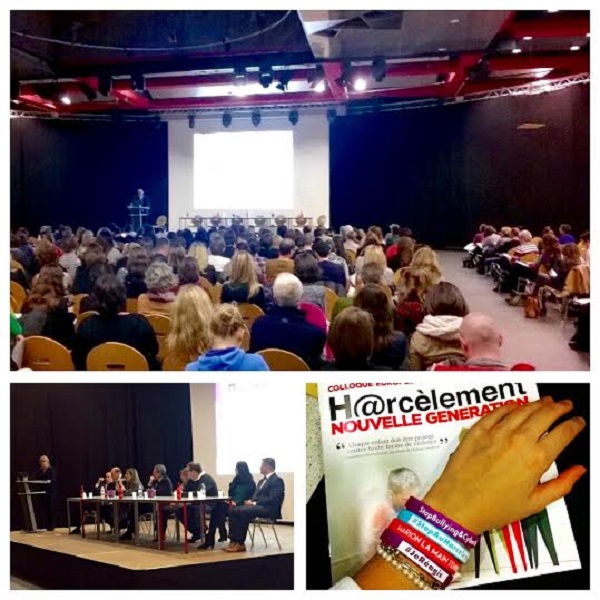
To educate everyone indirectly or directly concerned with school harassment and cyber bullying, psychologist and Psyfamille founder Catherine Verdier organised the European conference 'H@rcèlement nouvelle génération' which was held on Saturday 28 November 2015 at the Forum Geesseknäppchen in Luxembourg.
Bullying is a widely-covered issue in today's societies, as what was once a source of emotional and physical suffering for children and adolescents has now been greatly amplified through the advent of not-so-social networks. At Saturday's conference, eight experts defined the concepts of school bullying and cyber harassment and proposed solutions to them before an audience of 600 parents and education professionals.
"Bullying is never acceptable" were the words with which Catherine Verdier opened the symposium, which was aimed at better understanding the expansion of this dangerous phenomenon. "A child cannot be built on violence and aggression," she added.
She further explained that any child or teenager may one day find themselves in a situation of bullying. "There is no specific reason for why a student is being harassed: they will always be 'too much' or 'not enough' compared to ther rest of the class."
Jean-Pierre Bellon, a philosophy professor at a Clermont-Ferrand high school in France, stated that harassment is often done in groups, with this dynamic performing extreme pressure on each group member and retaining them in the harassment situations. "The harasser will not dare get rid of the group for fear of losing their reputation," he explained. "Fear is the cement of the group."
The experts further emphasised that the earlier bullying is detected, the greater the chances of bringing it to a peaceful end without harmful consequences it will be.
"Any sudden change in the behaviour of a harassed child must be an alarm for the parents," commented Catherine Verdier. Mental and physical consequences often involve loss of self-esteem, difficulty concentrating in school and psychosomatic illness, among others.
According to Bertrand Gardette, senior adviser for education at a high school in Clermont-Ferrand, treating harassment takes time and putting an end to a situation of school violence can sometimes be no easy feat.
"There is a lack of communication of the French education system on the methods to be adopted to prevent and stop harassment," Bertrand Gardette explained. "Teacher training on bullying is the Achilles heel of teaching. In all cases, adults should intervene in a situation of harassment, otherwise the process will never stop."
Nora Fraisse, author of the book 'Marion, 12 ans pour toujours' ('Marion, 13 Forever'), spoke of the importance in sensitising children to the issue of harassment from an early age, stating "Harassment and cyber harassment cases are starting earlier and earlier, particularly with the development of new technologies. That is why as early as kindergarten, children must be informed of this phenomenon. In the case of harassed children, it is important to make them aware that they will not keep their victim status throughout their lives."
In Luxembourg, there is no specific law to combat harassment, in schools or online. However, various initiatives are in place to combat this problem. Psychologist Georges Knell works with Bee Secure, an initiative supported by the Luxembourg government which aims to sensibilise every individual to cyber harassment.
"In Luxembourg, all students in Year 7 undergo mandatory training provided by Bee Secure," Georges Knell reported. "In my view, prevention of cyber harassment initially passes through the family circle, through support from parents."
Steve Goedert, Police Commissioner in Luxembourg, stated that the police are also trying to establish preventative action with the youth demographic: "At the beginning of each school year, we meet the country's high school students to discuss with them the risk of harassment and cyber bullying. The direct contact facilitates exchanges and strengthens our ties with the academic environment."
Georges Steffgen, professor at the University of Luxembourg and harassment and cyber bullying specialist, advised parents and teachers on how to end this trend: "Prohibiting the use of internet and mobile phones at school will not solve the problem of bullying, because the role of adults is in prevention and not in banning. Teaching civil courage at school would have more chance of reducing the cases of harassment and cyber harassment."
Photos by Harcélement Scolaire