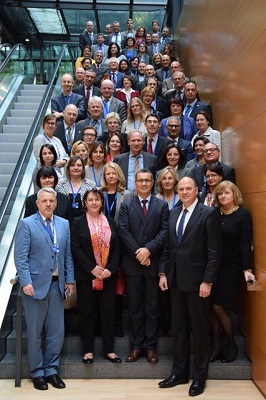
On 16 and 17 November 2015, the Luxembourg Presidency of the Council of the European Union held a meeting of Directors General of Vocational Training in the Grand Duchy.
At the meeting, Minister of Education, Children and Youth of Luxembourg, Claude Meisch, brought the attention of these present to the complex and difficult international context linked to the fate of refugees. According to the Minister, a significant humanitarian disaster is only avoided through cooperation between all the countries of the European Union. He further cited the work of the European Training Foundation (ETF) in the neighbouring countries of the Union as demonstrative of the sustainable contribution that vocational training and education can have to integration and social peace in societies.
A workshop was also dedicated to this issues, in which the importance of finding more flexible ways for recognition and validation of learnining outcomes for newcomers was emphasised. Language learning in the host country was found to be essential, which requires European cooperation and a platform for the exchange of good practices. The primary objective is to ensure that migrants are offered specialised support programmes with a view to avoiding any form of segregation.
The ambition of promoting equality, social cohesion and active citizenship forms one of the four strategic objectives of European cooperation in the field of education and training (ET2020). In this regard, efforts are being made to improve the basic skills, such as languages, science and mathematics of youth and adults, as well as significantly reduce youth unemployment, prevent school dropouts and increase the rate of graduates.
Professor Tanya Sammut-Bonnici from the University of Malta presented the effects of a sharing economy and the Internet of Things on human capital and professional skills. Representatives of the IT Management Education Centre in Luxembourg and the German Federal Ministry of Education and Research looked at pedagogical innovation in terms of infrastructure in schools, as well as a pilot project in Germany entitled 'VET 4.0' which suggest new structures for vocational training incorporating apprentissage in virtual worlds and combinations between different educational spaces and hybrid education paths.
There is a shortage of graduates in information technology, a field that is revolutionising the world with estimates suggesting that in 2020, 25 billion 'smart' objects will be connected to the internet and control different aspects of our lives. In this context, advanced skills in information technology and especially programming are of paramoun importance to maintain Europe's competitiveness. On the other hand, social partners have taken up the challenge of encouraging self-employment, which also requires the provision of suitable social security models.
The Directors General meeting was followed by a conference entitled 'Youth and VET: Reach Out and Move!' which brought together experts from every Member State. During this two-day conference, experts highlighted the possibility of cooperating with youth workers, who often have more direct contact with disadvantaged youth with special needs. This requires creating the necessary relationship of trust between various integration professionals and identifying effective ways to support youth employability.
Photo by MENEJ