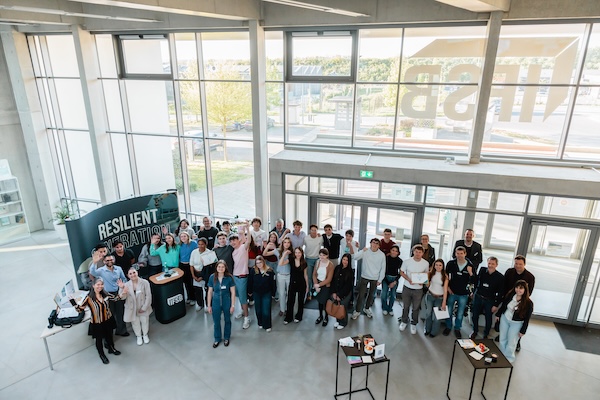
 Group photo;
Credit: Jonk Entrepreneuren Luxembourg © Pierre Levy
Group photo;
Credit: Jonk Entrepreneuren Luxembourg © Pierre Levy
On Thursday 23 April 2026, Jonk Entrepreneuren Luxembourg (JEL), in collaboration with the Institut de Formation Sectoriel du Bâtiment (IFSB), organised an Innovation Camp, an intensive one-day workshop, at the institute’s premises in Bettembourg.
The non-profit said the event aimed to engage young people in rethinking the future of neighbourhoods and the construction sector.
According to JEL, the event brought together 25 young people aged 16 to 19 from various Luxembourg secondary schools.
The challenge proposed by IFSB invited participants to project themselves into the future by addressing the question: “Imagine 2050: what will our neighbourhoods look like, and how will we live there?”
“A challenge designed for today’s young people, who will be the residents of our neighbourhoods in 25 years. An invitation to project themselves into their future and to imagine the living environments of tomorrow,” said Caroline Gontier (IFSB).
Divided into six teams, the students were supported throughout the day by six volunteers, Xavier Duboisdendien, Marcel Deravet, Marie-Alix Dalle, Carine Oberweis, Alexandra Kelleter and Fanny Remy, who coached them to develop concrete, innovative solutions adapted to the realities of the construction sector.
At the end of the day of reflection and creativity, the teams presented their projects to a jury composed of five members:
-
Paul Schossler, Director of Sustainable Construction at the Ministry of the Economy and Vice-President of the National Council for Sustainable Construction;
-
Carine Oberweis, Architect, expert in sustainable design, passive house designer;
-
Charlie Boon-Bellinaso, Civil engineer-architect, in charge of strategy and BIM standardisation at CRTI-B Luxembourg, manager of Activhome sàrl;
-
Luc Meyer, Director of Neobuild GIE;
-
Perla El Boueiz, Senior Advisor Sustainable Construction, Luxinnovation GIE.
First place went to Team “Auto Verse”, composed of Candice Boutoleau, Gaëtane Egerton, Sinan Bilsel and Valerio Gulli, which proposed a self-sufficient neighbourhood based on local renewable resources, featuring a central smart park, integrated services and solutions for water filtration and energy generation.
Second place went to Team “EcoVisionaries”, made up of Amélie Mendeleev, Lucia Carreiras, Timothée Gervis and Yoann Janeiro Campanha, which presented a fully sustainable and self-sufficient district called “Resilient Hood”, combining smart buildings, renewable energy and circular resource systems, with a focus on quality of life and zero waste.
Third place went to Team “The Green Loop”, consisting of Adriana Florez, Elisa Scotti, Octave Sohn, Romain Donnay de Casteau and Valentine Lyonnet, which proposed a low-carbon neighbourhood prioritising public transport and walkability, built with sustainable materials and supported by a circular economy model.