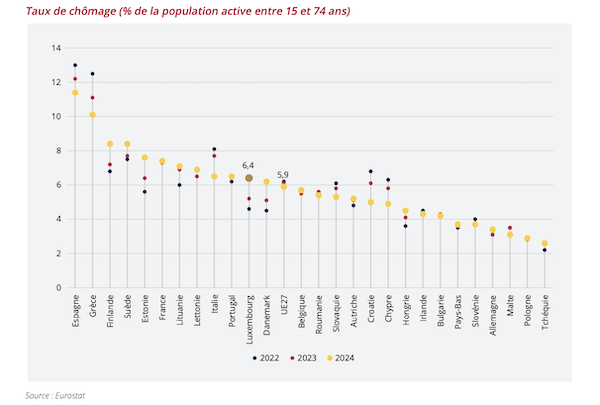
 Unemployment rate;
Credit: Eurostat
Unemployment rate;
Credit: Eurostat
On Tuesday 9 December 2025, Luxembourg’s Chamber of Employees (Chambre des Salariés - CSL) published a new EcoNews report highlighting the European Commission’s warning that the Grand Duchy faces mounting social challenges despite otherwise sound public finances.
According to the report, the Commission observed that Luxembourg is once again under scrutiny in the framework of the European Semester, as several key social indicators continue to deteriorate or fall short of EU averages. While the Grand Duchy maintains a solid budgetary position and a relatively balanced economic outlook, the Commission has launched an in-depth review to assess the risks these social developments pose to social convergence among Member States.
The CSL reported that Luxembourg recorded an unemployment rate of 6.4% in 2024, based on the definition of the International Labour Organization (ILO) - the share of people without work, available and actively seeking employment within the labour force. This represents an increase of 1.2 percentage points compared with 2023. The rate stood 0.5 points above the EU average, 3 points above Germany and 0.2 points above Belgium.
The CSL noted that the situation of young people is equally concerning. The rate of early school leaving rose by one percentage point in 2024, placing the Grand Duchy among the four EU countries with the sharpest increase. At the same time, 9.8% of young people aged 15-29 were neither in employment, education nor training (NEETs). While this remains below the EU average, the report highlighted that Luxembourg has seen a steady upward trend in recent years, in contrast to neighbouring countries and the European average, where levels have generally stabilised or declined.
Regarding income inequality, the CSL reported that Luxembourg displays relatively wide income dispersion: the richest 20% earn 4.7 times more than the poorest 20% - a ratio comparable to the EU average and France, but higher than Germany (4.5) and Belgium (3.5). Inequalities have also widened over the long term, with the period 2015-2024 marked by more pronounced disparities than the decade before.
The report further pointed to the limited effectiveness of social transfers in reducing poverty. In Luxembourg, such transfers lower poverty by just 27% - significantly below Belgium (53%), France (39%), Germany (36%) and the EU average (34%). In-work poverty remains the highest in the EU at 13.4%, despite a slight improvement in 2024.
Other indicators, such as the employment rate, real adjusted household disposable income per capita and child poverty risk, were flagged by the European Commission as areas “to watch”. Following its overall assessment, the Commission again placed Luxembourg “under surveillance”, as it did last year, citing unfavourable trends in unemployment, poverty, youth outcomes and social inclusion.
According to the CSL, the Grand Duchy now enters a second phase of analysis alongside Bulgaria, Greece, Spain, Italy, Lithuania, Romania, Latvia and Finland, and will need to step up efforts to reduce inequalities and improve the effectiveness of social policies.