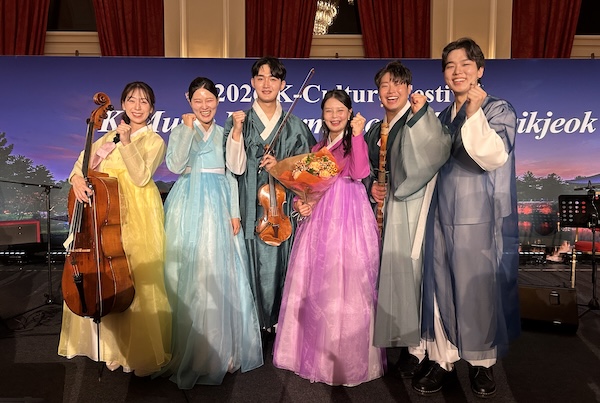
 (L-R) Park Yehyeon; Hwangbo Minkyung; Kim Hyeonsu; Jeon Jimin; Sim Sung; Kang Seongjun;
Credit: Elza Osmane, Chronicle.lu
(L-R) Park Yehyeon; Hwangbo Minkyung; Kim Hyeonsu; Jeon Jimin; Sim Sung; Kang Seongjun;
Credit: Elza Osmane, Chronicle.lu
On Thursday 1 October 2026, the Embassy of the Republic of Korea in Luxembourg, which officially opened in July 2024 and held its opening ceremony in September 2025, organised the K-Culture Festival taking place at the Cercle Cité in Luxembourg-Ville.
The event was an opportunity for attendees to experience Korean culture through a variety of food, various activities and a musical performance, with the event's poster promoting K-Food, K-Sool (liqueurs), K-Quiz, K-Art and K-Travel.
Comprised of two separate components, the Food Festival had two 90-minute sessions (from 13:00 to 14:30 and from 15:30 to 17:00), and the hour-long musical performance in the early evening.
The organisers confirmed that almost 500 people had registered to participate throughout the day, half for the food festival and half for the music performance.
Food Festival
Visitors were presented with cards, encouraging them to collect five stamps while exploring the event, with travel, food, drink, arts and a quiz, to qualify for a gift upon leaving.
The travel section/room (K-Travel) had information about travelling to Korea, including maps and tourist guides, as well as about Korean presence in Luxembourg, from the embassy, the Monument of Remembrance (including to Luxembourgers who fought in the Korean War), Korean language and culture classes, and the King Sejong Institute Luxembourg, to locations showcasing Korean Fine Arts, Martial Arts, beauty products and Korean restaurants and grocery shops.
The food (K-Food) was prepared by Korean chefs based in Germany and was served buffet-style in the Salon Bleu, with different Korean specialities on offer (some spicy), accompanied by rice punch. The food dishes included "Japchae" noodles and "Bibimbap", a rice-based dish with meat and vegetables, also "Kimchi", a side dish of salted, seasoned and fermented vegetables.
The drinks section (K-Sool) availed of the foyer bar, with a France-based Korean importer of Korean goods showcasing artisanal rice wines and liqueurs. Talking with Chronicle.lu, she explained that the industry is currently being revitalised after being almost wiped out following the Japanese colonisation in the early 1900s.
The arts section/room (K-Art) in the Salle Flamande offered calligraphy lessons, showing how to write one’s name in Korean.
The K-Quiz component offered attendees the choice of easy, medium and difficult questions.
Musical Performance
The six-piece Sanare group, described as a fusion Korean traditional music ensemble, performed for an hour in the evening in the main ballroom.
Using a variety of traditional Korean instruments,such as gayageum, daegeum and janggu as well as classical instruments piano, violin and cello, the group reinterpreted “traditional music through a contemporary lens”, as explained on the brochure.
The musical programme, entitled “Manpasikjeok - A Song for Peace”, comprised more than ten pieces composed or arranged by members of the group, including pianist Jeon Jimin, daegeum player Sim Sunguk and Kang Seongjung.
The programme combined traditional Korean music with pop medleys, internationally known K-pop songs and original compositions. The musicians had travelled from South Korea to Luxembourg for the performance, with Jeon Jimin telling the audience that they “love Luxembourg” and its “beautiful scenery”.
The performance was well synchronised and warmly received by the audience, who applauded after each piece and called the musicians back for the one last song after the programme finished.
Speaking with Chronicle.lu after the performance, the musicians also explained that their colourful “hanbok” (traditional Korean clothing), had been designed specifically for the group. They had selected the colours and other elements themselves to create personalised costumes for the ensemble.
Jeon Jimin, who studied classical composition, explained that she draws on Korean traditional musical techniques while adding elements of classical music and harmony. She said the arrangements were intended to bring out the distinctive sound and characteristics of each instrument, while the musicians also contributed to the solo sections written for their own instruments.
Asked how long it takes to create a piece, Jeon Jimin said that one of the opening pieces, Crimson Cry, had taken her around one hour to write, having emerged from feelings of sadness and sorrow. According to the brochure, the song expresses the “uniquely Korean sentiment of ‘han’, through the harmony of Korean and Western instruments, conveying the deep sorrow of loss through a crimson-toned cry”.
Sim Sunguk, meanwhile, estimated it way longer. “Ten years,” he said, explaining that an arrangement rests on the knowledge, skills and musical understanding developed through years of practice, rather than only the time spent writing it down.
ED/EO
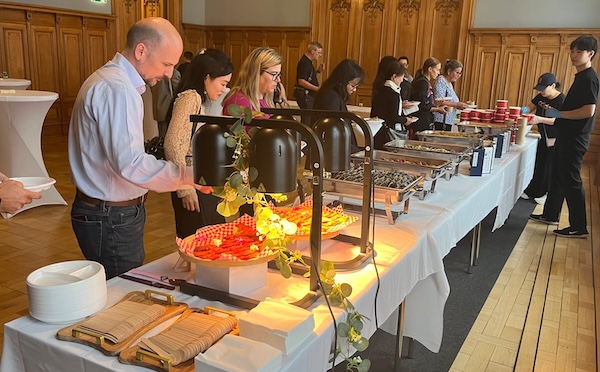
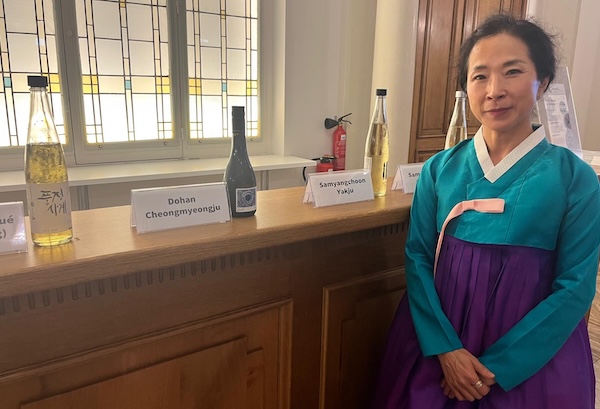
Photo Credit: Geoff Thompson, Chronicle.lu
UPDATED to correct the opening of the Korean embassy in Luxembourg