 Credit: Ievgenii Karanov, Chronicle.lu
On Monday 11 May 2026, the Luxembourg Chamber of Commerce held the conference “From Disruption to Resilience: Navigating Global Supply Chain Risks”, addressing current supply chain risks and exploring strategies to secure international operations.
The event brought together more than 80 participants to discuss growing challenges facing international value chains, including supply shortages, logistics constraints and rising human rights concerns, as companies seek to make cross-border operations more resilient and competitive.
Cindy Tereba, CTO and Director of International Affairs at the Luxembourg Chamber of Commerce, opened the conference by outlining the increasing pressure on international supply chains and the need for companies to strengthen resilience amid geopolitical, logistical and regulatory uncertainties.
In his keynote speech on the evolving supply chain risk landscape, Philippe Strebler, Head of Sustainability at the CERATIZIT Group, focused on the growing strategic importance of tungsten carbide and the vulnerabilities linked to global dependence on critical raw materials. He noted that more than 80% of global tungsten production is currently concentrated in China, describing tungsten as a “strategically sensitive material” essential to industrial tooling, aerospace and manufacturing applications. Referring to geopolitical tensions and Chinese export restrictions introduced at the beginning of 2025, he explained how CERATIZIT strengthened supply chain resilience through vertical integration, recycling and supplier diversification.
Philippe Strebler highlighted that the company now sources a large share of its tungsten from recycled materials, with CERATIZIT achieving a tungsten recycling rate of 91% in 2024. He also outlined investments in recycling technologies and partnerships with companies such as Stadler and Global Tungsten & Powders (GTP), aimed at improving traceability and reducing reliance on mined resources. Summarising the company’s approach, he argued that sustainability and circularity had become not only environmental priorities, but also strategic tools for industrial resilience, adding that “scrap collection is becoming the next battlefield” in securing future raw material supplies.
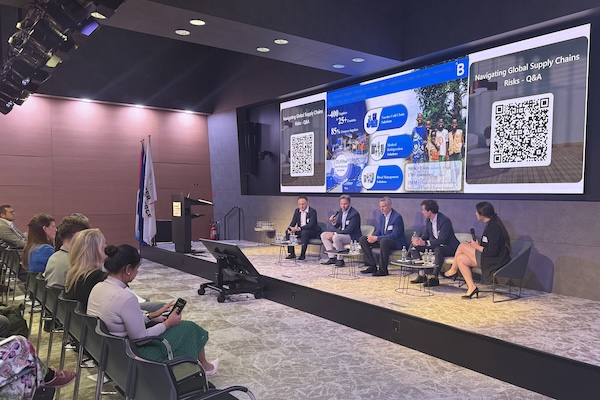
The keynote speech was followed by a panel discussion on designing and protecting international supply chains, featuring representatives from B Medical Systems, Marsh, Scrioo and Cluster for Logistics, who discussed how companies can strengthen resilience amid growing geopolitical, logistical, regulatory and cyber-related risks.
Philipp Regert, Head of Supply Chain at B Medical Systems, described how the Luxembourg-based medical cold chain company manages a highly international and project-driven supply chain, with around 400 suppliers across 25 countries and operations covering 170 countries worldwide. He stressed that resilience today depends on supplier diversification, digitalisation and agility, explaining that companies need better visibility not only over tier-one suppliers, but also across deeper layers of their supply chains. He also highlighted the importance of maintaining strong supplier relationships, dual sourcing strategies and limited safety stocks to cope with ongoing disruptions and fluctuating demand.
Marco Feiten, Co-Founder and Managing Director of Scrioo, warned that companies are increasingly overwhelmed by the scale and complexity of supply chain risks. He explained that Scrioo’s AI-based platform monitors millions of global data sources to identify risks linked not only to suppliers, but also to customers, covering areas such as sanctions, ESG compliance, financial risks and geopolitical developments. According to him, one of the biggest challenges for companies is information overload, making it increasingly difficult to identify which risks are genuinely relevant and require action.
Tim Merci, Head of Risk Consulting BeLux at Marsh, emphasised that many supply chain risks remain either underestimated or entirely uninsurable. While insurance can mitigate certain risks, he noted that around 70% of corporate risks cannot be fully covered through traditional insurance solutions. He pointed in particular to geopolitical tensions, climate-related natural catastrophes and “non-damage business interruption” events, such as blocked trade routes or regulatory disruptions, which can severely affect operations without causing physical damage. He also warned that companies often underestimate the financial impact of supply chain interruptions when assessing risk exposure.
Daniel Kohl, Director of Cluster for Logistics, highlighted the operational challenges linked to logistics disruptions and growing pressure on global transport systems. He argued that companies rely too heavily on single transport routes and should instead prepare alternative logistics solutions across air, sea and rail freight. He also stressed the importance of real-time visibility over transport capacity, emissions data and regulatory developments, warning that geopolitical tensions, cyberattacks and tax changes can rapidly disrupt international supply chains.
Concluding the discussion, the panellists broadly agreed that companies should prioritise greater visibility across their supply chains, stronger internal coordination and improved preparedness for future disruptions. Among the key recommendations highlighted were investing in AI-driven risk monitoring tools, diversifying suppliers and transport routes, building stronger supplier relationships and ensuring companies remain agile enough to respond quickly to geopolitical, cyber or climate-related shocks.
Beyond the panel discussions, the conference also featured presentations on practical support available to companies navigating international supply chain risks and global expansion. Sabrina Kohn, Senior Sustainability Advisor at the House of Sustainability, presented the Human Rights Pact initiative, while Adélaïde Hoffsess and Thomas Brice from the Luxembourg Chamber of Commerce outlined internationalisation support services available to Luxembourg-based companies. Basak Baglayan, Secretary of Luxembourg’s OECD National Contact Point and ESR Expert, also presented mechanisms related to responsible business conduct and international guidelines.
The conference concluded with a networking cocktail and information stands dedicated to sustainability and internationalisation support services.