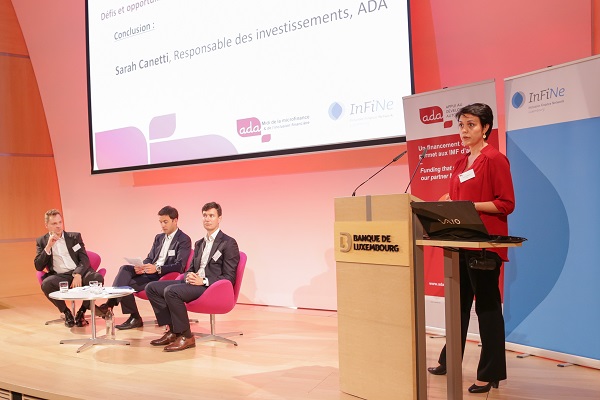
The 35th Midi de la Microfinance organised by ADA was held on Wednesday lunchtimne at the Banque de Luxembourg.
Martin Heimes of the Swiss fund responsAbility and Kaspar Wansleben of the Luxembourg Microfinance and Development Fund (LMDF) pointed to the challenges and opportunities of socially responsible funds, specifically microfinance investment vehicles, with Gillin of Innpact and Sarah Canetti, head of investment services at ADA, also contributing.
After 20 years of existence, microfinance investment vehicles have attracted 11 billion USD, of which 50% are hosted in the Grand Duchy. Furthermore, these funds have in recent years seen a growth between 10 and 15%.
ResponsAbility, originally created for impact investing, today concentrates 80% of its microfinance activities for a total of €1.7 billion invested! The fund works with 200 microfinance institutions (MFIs) and target mainly large structures: 58% of financed MFIs hold more than 50 million US dollars of assets.
Smaller, but no less powerful, the Luxembourg fund LMDF manages €25 million of assets. The team specialises in ADA-advisesd LMDF investment funds in the choice of partner MFIs. ADA is an NGO, the partnership has as its primary mission social performance, i.e. to support emerging MFIs, often overlooked by large funds because of the risk and costs associated with this funding. 20% of MFIs that ADA and LMDF select actually benefit from their first financing by an international investor. This shows the importance of the two Luxembourg players for development. In addition, 70% of MFI partners benefit of other skills of the NGO, such as technical support or many courses that develop the skills of the management of these institutions. To finance these small MFIs targeted by large funds, but which nevertheless affect particularly marginalised populations, remains one of the challenges of the sector.
Sarah Canetti, responsible for investment in ADA, has highlighted this problem concerning the concentration of funds in favour of large MFIs, and thus in spite of emerging MFIs: 98% of MFIs have only 6% of funding MIV - these small organisations need funding to exist and develop.
Other challenges were also discussed at the conference, including the complicated macro-economic situation in some areas (e.g. in Central Asia) and the structural fragility of MFIs which makes the job of investors more risky. Many countries still need funding to expand financial inclusion of its people. If VIM growth will be lower in the future, diversification into new sectors (environment, Fintech, SMEs) constitutes new development paths. In this area, expertise remains particularly valuable.
Photo © Luc Deflorenne / ADA