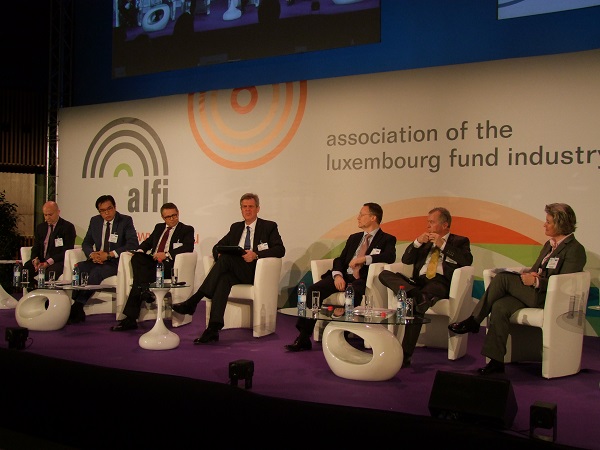
On Tuesday morning, the 2-day ALFI Spring Conference 2016 kicked off at the European Conference Centre with 670 attendees attracted by the conference topic of "Future Perfect".
One of the panel discussions involved "The Millennials - New generation, new investor attitudes, new tools", moderated by Julian Presber, Co-ordinator Relations with the Financial Centre, University of Luxembourg, involving Panelists including: Martyn Cuff, COO, Allianz Infrastructure Transformation, Allianz SE; Daniel Häfele, Chairman of the Board of Directors and CEO of ACOLIN Fund Services AG, Zurich; Mandakh Munkhbayar, Student, Université du Luxembourg; Kim Pilgaard, Managing Director, Nordea Investment Funds S.A., Luxembourg; and Justin Wilson, Managing Director, Endava GmbH.
The term Millennials refers to people born roughly between 1980 and 2000. Julian Presber described this grouping as requiring mass information and transcations via modern and future technologies. He acknowledged that it is very difficult to make predictions, and stressed that the one thing to remain the same is that we, as people, will still be involved.
For the millennial investor, he categorised them as being connected,independent and "it's all about me". The oanel discussed the issue of smart devices which are going to develop in the future to become the biggest single change in the future life of the individual providign online access and functionality offering a range of services, including transactional. He said that around 50% of Americans own equity, with the figure in Europe only around 10%.
The panel discussed the issue of the Millennial being hit by the financial crisis and asked does the Millennial investor actually exist, as they find it difficult to get on the property ladder due to student loan debts, high downpayments required, etc., as well as Millennials growing up through the Dot.Com and sub-prime crises which did not exaxtly encourage people to invest. The issue of savings was discussed, as was the tech-savvyness of millennials. Ease of access to investments, however, may be a way in for millennial investors.
With tech platforms offering an attractive force for investing, there is much information "out there" but also an information gap providing potentially an information paradox.
One solution is to become a champion of the consumer, with transparent investing. There is an information gap between investors and the investment community. Young people still need professional advice to differentiate between fact and fiction, before investing.
On the issue of financial inclusion, most assets are accessible now via technology, with rich investors beign provided access to projects at the top end of wealth management.
One the one side technology gives access to information, yet technology cannot do anything about desire or appetite of investors. A lot of work has been made recently on behavioural economics.
On the issue of chat rooms, messages travel fast and responses arrive quicker than with traditional telephone calls, etc. The moderator also criticised governments for their reticence in introducing financial education into classrooms, but asked would the solutions present themselves. Investments are complicated and the outcomes are unclear. It is about making the person in the street a qualified consumer, providing them with the understanding of the basic risk, but not necessarily the complexity behind the scenes.
Further financial education was advocated by members of the panel. However, the issue of the cost of such financial education was raised, as well as how financial education will be taught, with traditional educational methods replace by other means offering speed and short timings, e.g. through gaming.
The ALFI Spring Conference continues later today (Tuesday) and all day Wednesday in Luxembourg-Kirchberg.
Photo by Geoff Thompson