On Thursday, the 10th edition of the Economy Day organised by the Ministry of Economy, the Chamber of Commerce of Luxembourg and FEDIL - Business Federation Luxembourg, in collaboration with PwC Luxembourg, was held as the Chambre de Commerce in Luxembourg-Kirchberg, on the topic of "Investing in Talent".
Carlo Thelen, CEO of the Chamber of Commerce, opened by saying that the small economy of Luxembourg is continually challenged by global megatrends. The topic is about finding a common ground, with Luxembourg having proven to be resilient. For more than 100 years Luxembourg's tradition of welcoming migrants has given it a large advantage over other economies. The German economy appears to be remarkable robust in different industries and services, but many industrial organisations are concerned at economic policies and rising labour costs. In the Grand Duchy in 2014, a net immigration of 11,000 people was recorded, the highest rate in Europe; and the number of cross-border workers grew by almost 5,000 in the same period. Luxembourg's government is working on developing the country's infrrastructure and accommodation needs. While the issue of the Schengen agreement and border controls are being threatened by security concerns, he admitted that its potential breakdown could be a disaster for Luxembourg.
He said that Luxembourg is ranked 3rd best talent hotspot out of 61 countries in a recent survey; yet Luxembourg must continue developing its workforce / talent pool. Higher potential mobility of the future workforce can be considered as a major opportunity for Luxembourg to attract talent.
He also addressed the issue of secondary school education in Luxembourg and presented statistics which revealed that only 40% of students complete secondard education on schedule, significantly behind that of other countries, and called on educational reform to help grow the talent pool from within the Grand Duchy.
John Parkhouse, CEO of PwC Luxembourg, referred to the PwC CEO survey which revealed that 63% of CEOs acknoeledged that they are concerned about key skills and talents. He emphasised that new skills are needed as we migrate from an industrial world through to a service industry and the digital economy and Internet of Things. We need to prepare for the future even though we may not know where the future is heading. We need a flexible workforce where people change as their business changes. Talent Strategy is a challenge for both business and government, including developing a culture around it. In a few years' time, 27% of the world's workforce will be millennials - we need to change now to attract and retain this new workforce.
On Luxembourg, he stressed the split between the state and private sector and identified the strength of the international workforce here. He said that the focus on gender issue is a big thing for PwC Luxembourg with the workforce almost at 50-50, and admitted that gender balance at partner level has still some way to go. The Grand Duchy is well positioned to attract the best talent, with just Switzerland and Singapore higher in the talent hotspot league. He also referred to Luxembourg's Nation Branding initiative: we do a good job of attracting companies to Luxembourg as a great place to do business, but we do not do a good job of promoting Luxembourg as a great place to live: this has to change. "I couldn't think of a better place" he acknowledged, in reference to Luxembourg as a place to do business and to live.
He revealed that PwC Luxembourg interviews around 12,000 people annually, resulting in around 800 hires.
Dr. Rainer Klump, President of the University of Luxembourg, addressed the role of the University of Luxembourg, and Sasha Baillie of the Ministry of Economy presented the Nation Branding initiative before the attendees broke out into parallel workshops before coming together again for plenary sessions.
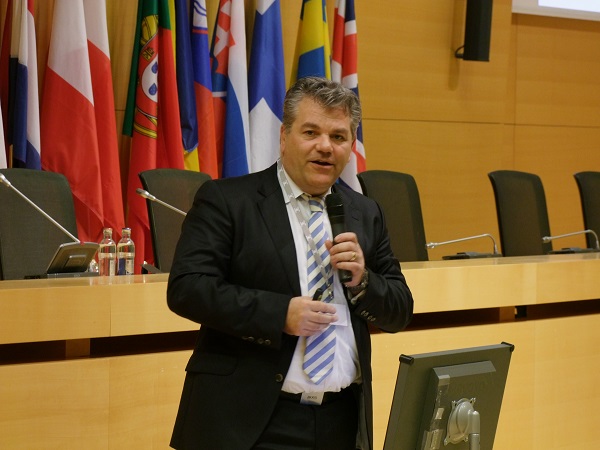
Photos by Geoff Thompson (above): John Parkhouse, PwC; (below): Carlo Thelen, Chambre de Commerce; (bottom): Dr. Rainer Klump, University of Luxembourg