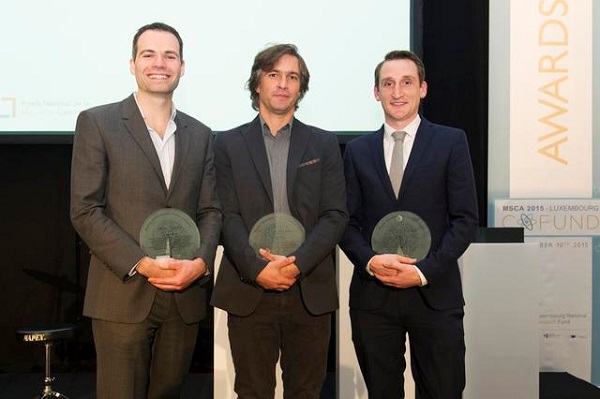
The interpretation of whistled languages through cognitive science, the analysis of big data for health purposes and the development of innovative osteoporosis treatments were each the subject tackled by the winners of the Marie Sklodowska-Curie Actions (MSCA) 2015 - COFUND awards, announced during an international gala which took place at Cercle Cité on Thursday evening.
Dr. Julien Meyer, Dr. Aiden Doherty and Dr. David Hoey, each funded by the COFUND scheme, were honoured for their excellent research at the Awards Ceremony, receiving prizes jointly presented by conference key speakers Claudie Haigneré, former French minister, astronaut and researcher and Martine Reciherts, Director General of DG Education and Culture of the European Commission, as well as Marc Schiltz, Secretary General of the Luxembourg National Research Fund.
A senior research fellow at the University of Oxford, Dr. Aiden Doherty has established himself as a research leader in the analysis of sensor data for the understanding of human behaviour. He has focused on the development of computational methods to extract sensical health information from complex and noisy sensor data in very large health studies. The objective of Dr. Doherty's work finds him at the intersection of medical sciences and computing and builds on experience in computing departments at Microsoft Research and Dublin City University, as well as population health and biomedical engineering at the University of Oxford. His research combines academic and non-academic collaborations, as encouraged by MSCA, and has made definitive steps towards more clearly understanding lifestyl health behaviours and their associated health outcomes.
Dr. David Hoey is an Associate Professor in Biomedical Engineering at Trinity College of the University of Dublin and held his COFUND postdoctoral fellowship at Columbia University in 2009-2011. His pursuit of cutting-edge fundamental research into developing innovative treatments for bone-loss diseases such as osteoporosis has seen Dr. Hoey receive several professional awards and honours at Columbia University, including the 'New Investigator Recognition Awards' at the Orthopaedic Research Society, and several prestigious invitations. The jury cited Dr. Hoey's findings as a relevant contribution to an emerging research domain in the development of innovative therapeutic approaches.
Dr Julien Meyer, the leading expert in the area of whistled languages has recently joined the CNRS GIPSA Laboratory in Grenoble, France having worked for years in Amazonia in Brazil. Dr Meyer began his research on languages in 2002, when he entered the linguistic doctoral program at Lyon 2 in the area of Cognitive Sciences.
During the COFUND phase at the Lyon’s Collegium, he wrote a book: «Whistled languages - A worldwide inquiry about whistled speech», which is based on an impressive first-hand experience of whistled languages in various parts of the world (France, Spain, Greece, Turkey, Thailand, Laos, Mexico, Brazil, Morocco, ...) and is now considered to be the reference book of the domain. He launched several international collaborations, including some between the Linguistics division of the Museu Goeldi, his former Brazilian host institution and several research institutions in France, all the while being very active with publishing articles, participating in conferences and giving invited talks.
In the aftermath of his COFUND fellowship Dr Meyer was granted an Individual Marie-Skłodowska-Curie Fellowship that enabled him to work on the Iconicity and Ecology of languages.
Thanks to his original approach to tackle different issues related to different forms of speech in a large diversity of languages in Europe, Asia and South America he anchored his studies in a cognitive perspective. His work shows that whistled languages do indeed reflect the phonology—the basic sound elements—of spoken language. His first papers on iconic transformations of singing with musical instruments in the Amazon region open new perspectives on the fascinating topic of music-language relations in human communication. With Dr Moore, he recently, co-authored a paper on ‘The study of tone and related phenomena in the Gaviao of Rondônia tone language” which added a solid international dimension to his steadily growing reputation as a leading young scholar.
Julien Meyer has more recently worked on analysing spoken and whistled speech with Siberian Yupik speakers and traditional whistlers in the Moroccan Atlas region. He is also developing long term projects of documentation of several endangered languages.
The EU-funded research has enabled Dr Meyer to become one of the world’s leading expert in his field and the results of his research might, in the future, well lead to innovation in fields such as telecommunication or voice transmission, and have a major impact on the preservation of our traditional linguistic heritage worldwide.
Photo by 2015 Marie de Decker