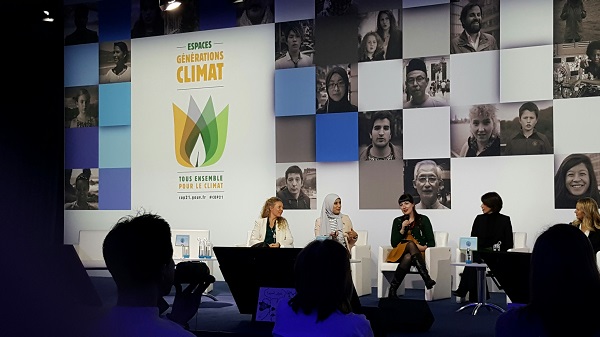
Luxembourg's answer to Jamie Oliver, television chef and cookbook author, Anne Faber, was in Paris as part of a panel presenting the initiative Meat-Free-Monday at the COP21 climate conference.
Speaking at the Nelson Mandela auditorium, speakers discussed the idea and their experiences with the initiative, which aims to give the public a subtle way of considering the idea of consuming less meat.
While most of the panelists were vegetarians or vegans, Anne Faber declared herself a "flexitarian" – someone who occasionally eats meat. She shared how she used to be a vegetarian for nine years, but, having become a cook, she was too intrigued by all the opportunities that the preparation of meat would allow her, using small amounts of meat essentially as a spice rather than as the main ingredient. Nonetheless, her cooking recipes have frequently also been entirely vegetarian dishes. Like this, she admits, she has "sneaked" vegetarian options into the diet of Luxembourgers, who traditionally are very heavy meat eaters. A study in 2012 went as far as calling Luxembourgers the "number one consumers of meat per person in the world". However, these numbers were inflated by the large amount of frontaliers working - and eating - in Luxembourg. Still, the amount of meat consumed per Luxembourger is around 90 kilos per year, and thereby in the absolute top tier of worldwide meat consumption. The suggested healthier level would be below 30 kilos.
While the main focus of Meat-Free-Monday is usually human health and animal welfare, in Paris the focus of the initiative was on climate change. Under the motto "Less meat – less heat", the environmental problems of animal farming were highlighted and discussed. 78 billion animals exist today on the planet whose purpose it is to be food for humans, with beef being the most environmentally problematic, and poultry being the most numerous. In particular it is the raising of animals on an industrial level, and the necessary mass cultivation of feed crop, which causes the worst environmental impacts. Every year, the EU imports 30 millions tons of soy from South America, where its production is a key factor in driving deforestation. Furthermore, this soy can be genetically modified, and while genetically modified animals are not allowed in Europe, the import of genetically modified animal feed is a common practice.
What will come as a shocking surprise is that no other single field of human activity produces as many greenhouse gases than animal farming with 14.5% of worldwide emissions. Traffic of all kind, including shipping, air travel and cars combined creates slightly less greenhouse gases at 14%. The first number also includes the release of greenhouse gases from turning over land, the use of oil-based fertilisers, to the significant - if admittedly funny sounding - problem of methane released by cows. Yet until now, the sector has succeeded not to be part of any obligatory cuts in greenhouse gas emissions. With the situation of the world climate now in an advanced state of distress, it looks like for the first time animal farming is going to be at least mentioned in the final document of the COP21 conference.
The influence of both the meat industry, as well as the policy of heavy agricultural subsidies, have completely perverted the trend towards meat consumption in developed nations. Up to 30 times the amount of animal feed has to be grown for the same amount of calories from beef, than if humans ate the vegetable product themselves – certainly a process that is not sustainable in a world where 870 million people still suffer from hunger. And looking at the price of meat versus vegetables, the fact that vegetarian dishes are frequently more expensive than the carnivore equivalent shows that the subsidy system is in dire need of an overhaul.
Traditional cooking has changed drastically over the last hundred years, and more and more countries are taking on a western way of eating, especially fast food. This has had a disastrous result for peoples health and for the planet overall. But the alternative is as simple as it is productive: a reduction in personal meat consumption could be great for ones health, but also a significant contribution to help achieve the goal of staying under 1,5° global temperature rise. Trying the vegetarian recipes by Anne Faber, posted every Monday on the "Meat Free Monday Luxembourg" page on facebook, would be a healthy and tasty option for everyone, with a larger than expected contribution towards fighting climate change.
Photos by Nicolas Neuhold