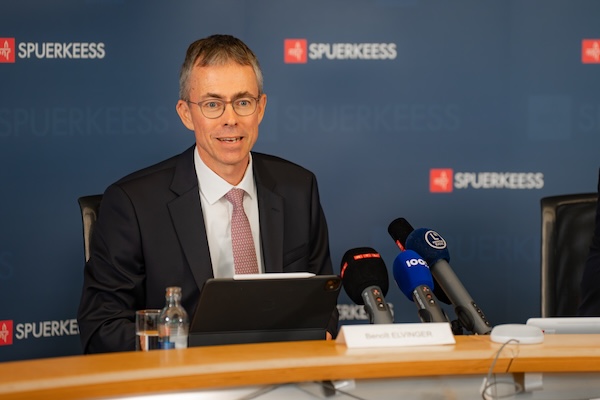
 Benoît Elvinger, Spuerkeess Chief Executive Officer (since 1 October 2026);
Credit: Spuerkeess
Benoît Elvinger, Spuerkeess Chief Executive Officer (since 1 October 2026);
Credit: Spuerkeess
On Tuesday 29 September 2026, Luxembourg bank Spuerkeess (Banque et Caisse d'Épargne de l'État, Luxembourg) held a press conference to present its incoming Chief Executive Officer Benoît Elvinger and outline his priorities ahead of officially taking up the position on Thursday 1 October 2026.
According to the Bank, Benoît Elvinger intends to build on Spuerkeess's strength, the relevance of its strategy and the expertise of its teams to accelerate its transformation and continue its mission in the service of the country, against the backdrop of a banking sector marked by geopolitical uncertainties, intensifying competition, evolving regulatory requirements and technological acceleration.
Wholly owned by the Luxembourg State, directly supervised by the European Central Bank (ECB) and governed by its own law, Spuerkeess occupies a particular position in Luxembourg's financial landscape. Article 5 of its organic law entrusts it with the mission of promoting savings and contributing, notably through its lending, to the economic and social development of the Grand Duchy.
“A state-owned bank is not a bank like any other. In addition to carrying out its business, Spuerkeess has a mission. To be able to fulfil it sustainably, we must be strong, efficient and act with a long-term perspective,” said Benoît Elvinger.
According to Spuerkeess, this mission is reflected in particular in financing housing, supporting SMEs and start-ups, assisting clients in their energy transition and promoting financial inclusion. It also involves contributing to the competitiveness of Luxembourg's economy and financial centre, in full compliance with competition rules and the regulations applicable to banks.
Benoît Elvinger also stressed the complementary role of digitalisation and human advice. With more than 40 branches, six financial centres and a banking application, Spuerkeess intends to combine the speed of digital services with the expertise of its advisers, particularly for decisions such as purchasing a home, creating or transferring a business, dealing with an inheritance or making an investment choice.
“Our clients should not have to choose between the speed of an application and the personal attention of an adviser. Our responsibility is to offer them both,” he added.
The Bank also identified payments, the digitalisation of securities, artificial intelligence and cybersecurity among the areas expected to transform the banking sector over the coming years. Its technology investments are intended to improve the quality and simplicity of services offered to clients, strengthen risk management, consolidate operational resilience and increase the Bank's competitiveness.
Artificial intelligence is expected to play a growing role in this transformation, although Spuerkeess stated that its use would take place within a clear framework, with rigorous protection of sensitive data and investments in employee training.
“We will not innovate simply to follow a trend, but to remain competitive and better serve our clients. We will make no compromises on data security and confidentiality,” stressed Benoît Elvinger.
Benoît Elvinger said he fully aligns himself with the continuity of the strategy defined by the Board of Directors and the Bank's Management. In addition to financial strength, the strategy is based on commercial leadership, technology, risk culture and Spuerkeess's attractiveness as an employer.
“The strategy is clear and relevant. I fully embrace it. My ambition is not to change its direction, but to accelerate its implementation in order to respond more quickly to changes in our environment and our clients' expectations,” he concluded.
Benoît Elvinger will succeed Françoise Thoma, who will remain Chief Executive Officer and Chair of the Executive Committee until Wednesday 30 September 2026. Benoît Elvinger will take over both positions from Thursday 1 October 2026.
Spuerkeess stated that it will present concrete initiatives in spring 2027 aimed at accelerating the implementation of this strategy.