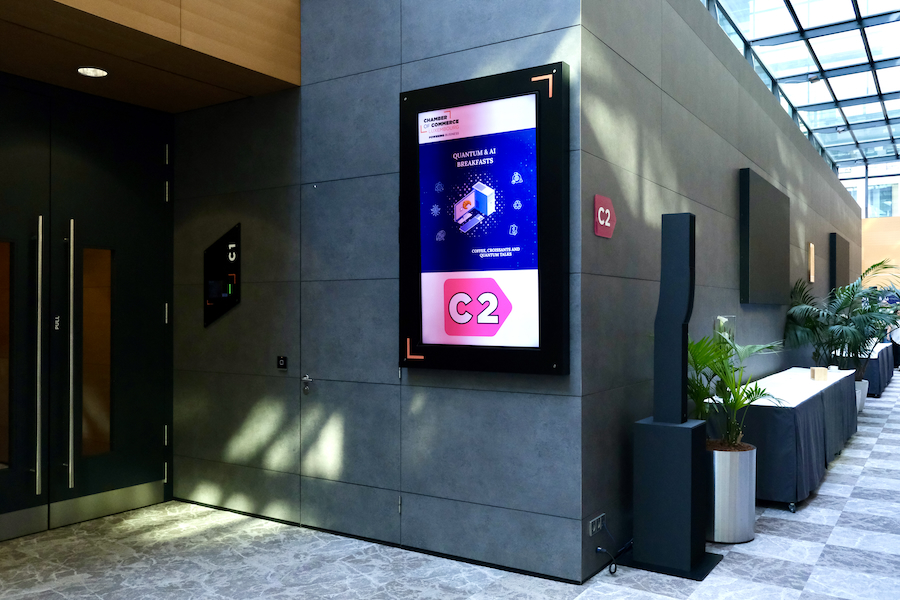
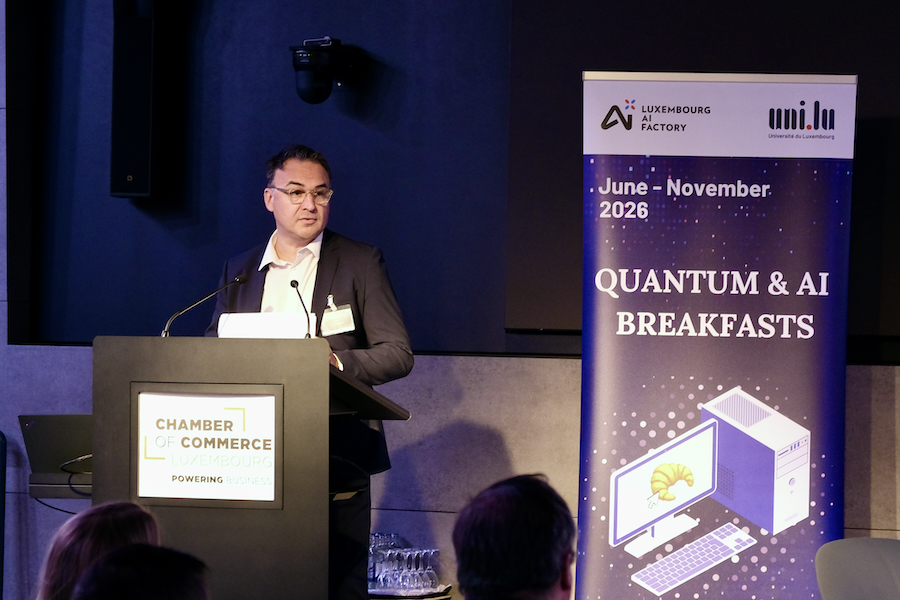
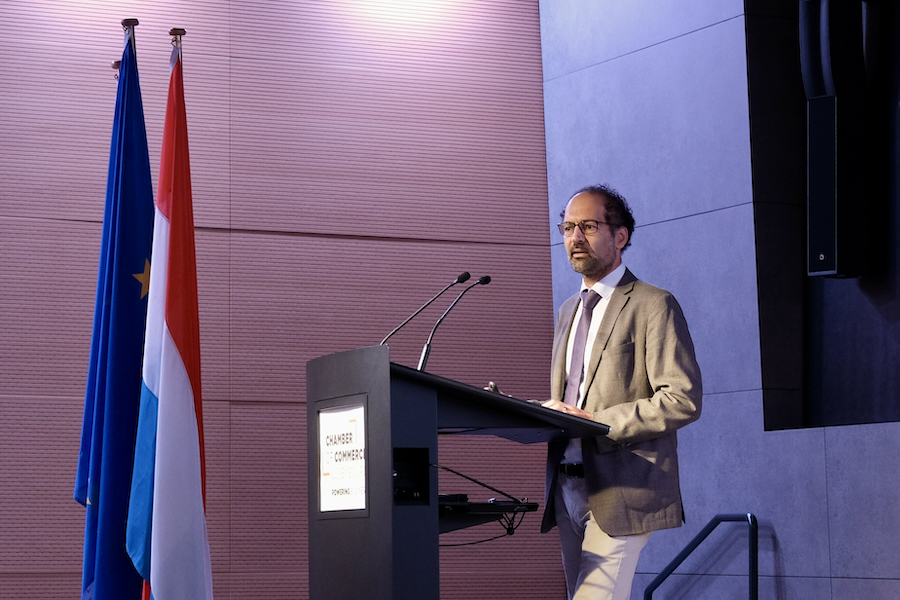
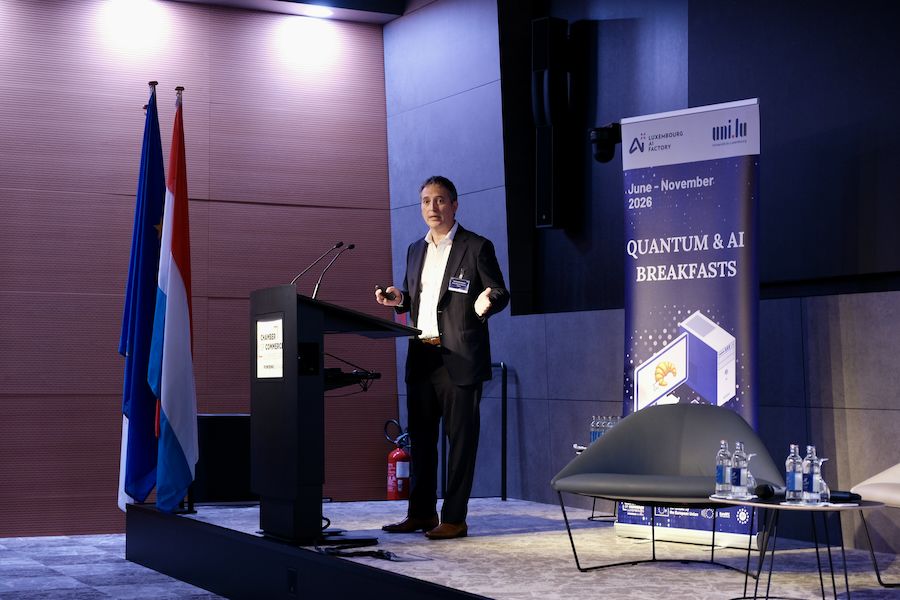
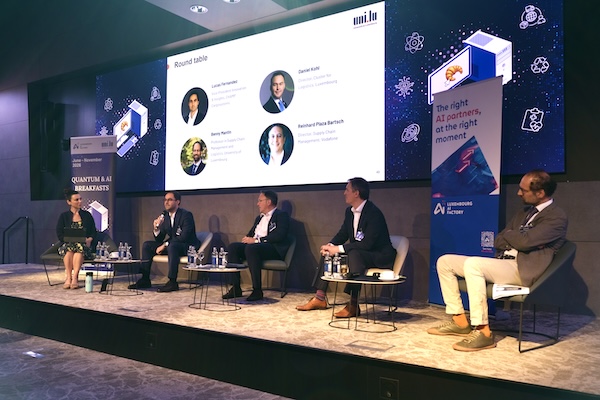
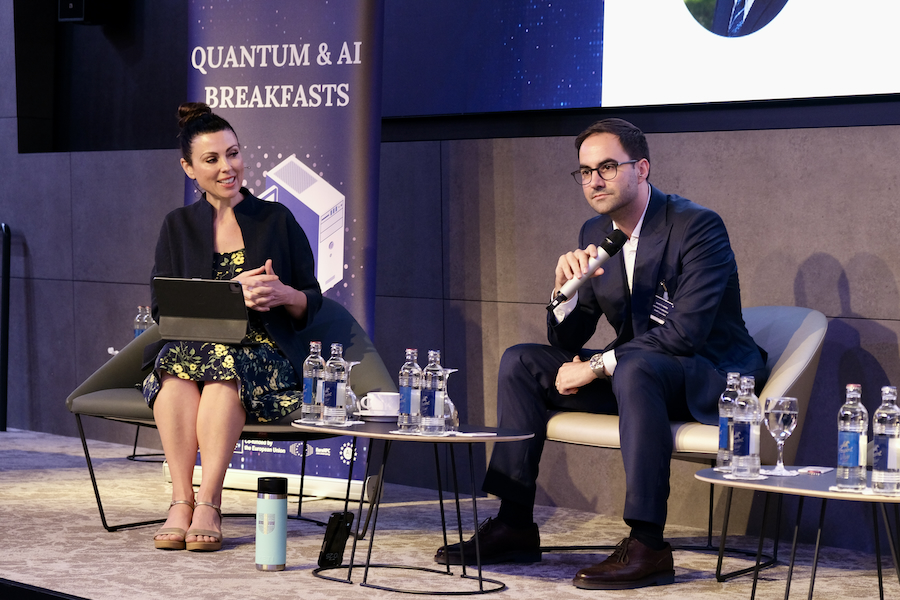
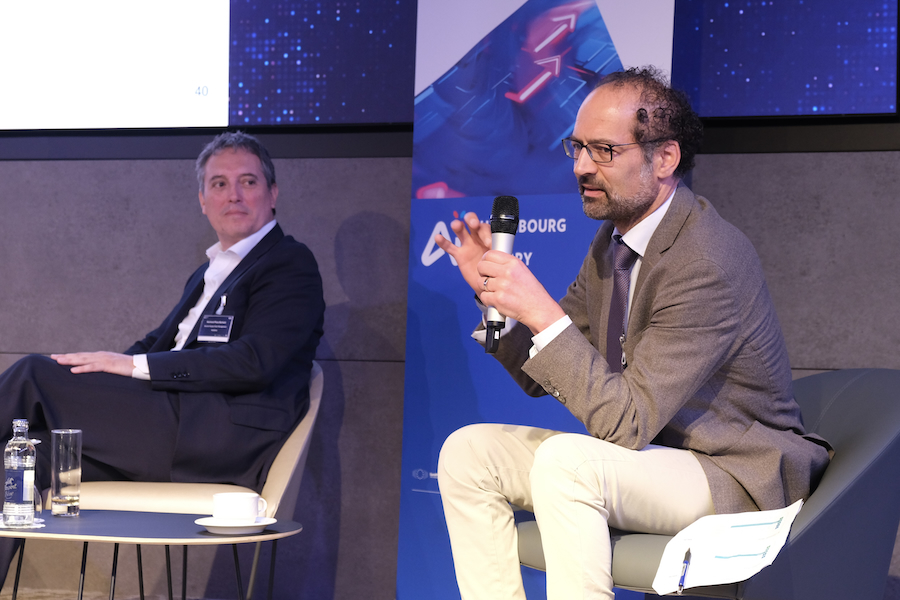
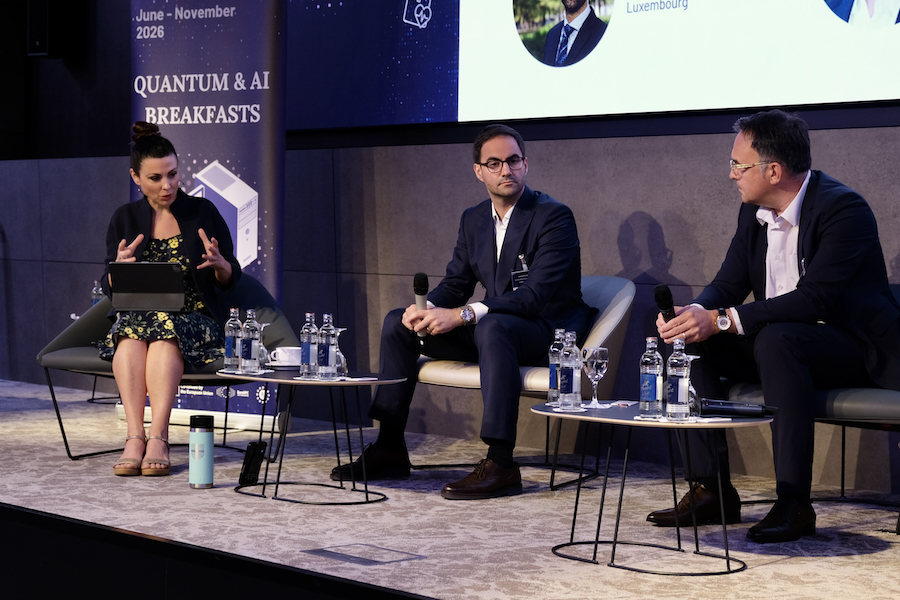
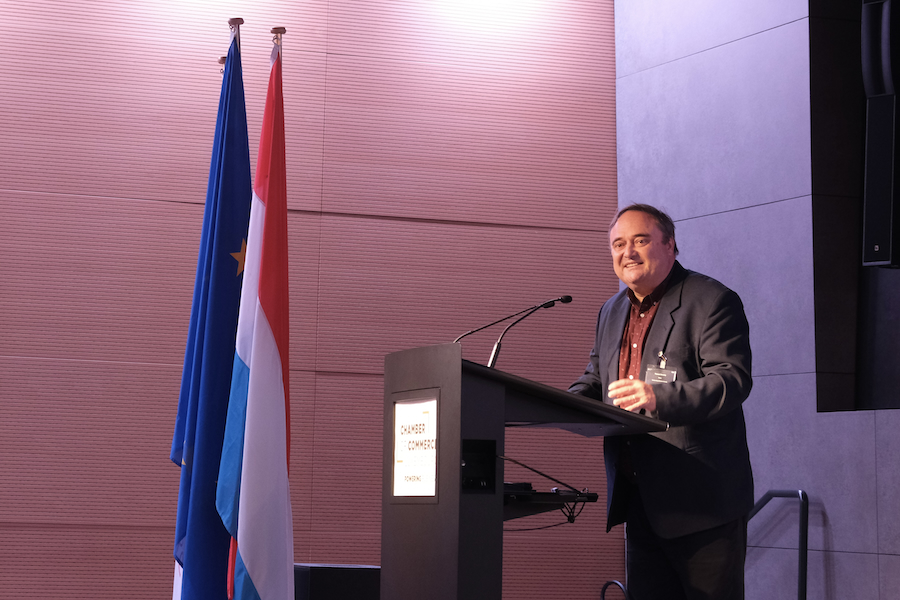
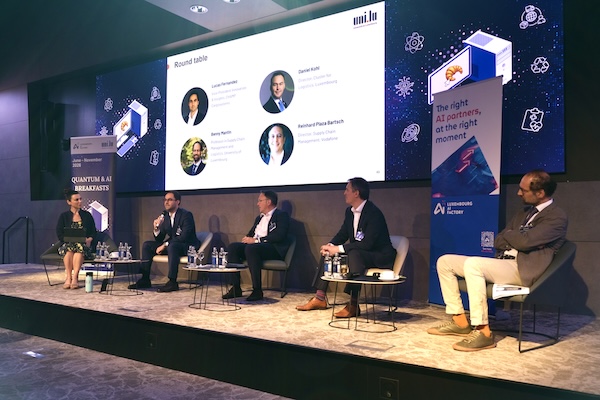
 (L-R) Lisa Burke, Lucas Fernandez; Daniel Kohl; Reinhard Plaza Bartsch; Benny Mantin;
Credit: Steven Miller, Chronicle.lu
(L-R) Lisa Burke, Lucas Fernandez; Daniel Kohl; Reinhard Plaza Bartsch; Benny Mantin;
Credit: Steven Miller, Chronicle.lu
On Wednesday 17 June 2026, the University of Luxembourg, in conjunction with the Luxembourg AI Factory, hosted the first of its new season of Quantum Breakfast events at the Luxembourg Chamber of Commerce in Luxembourg-Kirchberg.
Following the success of the quantum and AI-based seminars in 2025, the University of Luxembourg will again host a series of monthly talks about Luxembourg’s place in cutting-edge computing world throughout the remainder 2026.
The first of these focused on the subject of artificial intelligence in relation to logistics and supply chain management and welcomed guest speakers Director Supply Chain Management at Vodafone, Reinhard Plaza Bartsch, Professor in Logistics and Supply Chain Management at the University of Luxembourg, Benny Mantin, Vice-President Innovation & Insights at CHAMP Cargosystems, Lucas Fernandez, and Director at Cluster for Logistics, Daniel Kohl.
The event, hosted by presenter Lisa Burke, began with a welcoming speech from Daniel Kohl, who spoke of a “moment of transformation” built on a shift from an era where the systems, rules and trusted assumptions are “no longer enough”. He noted that logistics has been “the invisible force that kept the world moving” for decades, but today the question is not “how do we improve logistics, but how do we reinvent it”.
Daniel Kohl emphasised: “AI is the intelligence layer of the new supply chain. Artificial intelligence is one of the tools, a new form of intelligence entering the industry. AI does not ask what happened but rather what will happen next…It converts overwhelming complexity to clear and actionable intelligence. AI does not replace people. AI elevates them.”
Benny Mantin, then spoke on the subject of intelligent supply chains and how artificial intelligence (AI) will reshape the field of logistics and noted: “Supply chains are at the core of value creation. They are the skeleton of how we move goods and services around the globe.”
Following an overview of the historic routes of ancient merchant trade, through to the impact of the industrial revolution and up to today’s complex supply chain networks, Benny Mantin noted that the use of AI in the supply chain is about reducing frictions, removing uncertainty and helping businesses make better decisions, but that this would not remove the human element from the process.
He then discussed a framework which he said should be considered as part of the process of integrating AI into supply chain management, which includes a focus on areas such as implementation strategies, AI infrastructure, scaling the integration of AI into existing systems, procurement and networking decisions and defining how humans will interact with these AI systems.
Benny Mantin remarked: “In the AI supply chain, there are multiple challenges. If we want to have a successful implementation of AI, we need to make sure we have the right supply chain in place.”
Reinhard Plaza Bartsch then spoke of the logistical transformation projects taking place at Vodafone and how the use of logistics has been a key part of how the company operates and develops.
He stated: “A key piece for me is really AI in itself is not a transformation. AI is actually complementing transformation, how we change the way we run our supply chains.”
Having recently made significant changes to its operating model, Reinhard Plaza Bartsch spoke of Vodafone’s challenges of integrating AI into its procurement chain, how to ensure these systems are accepted by users, the importance of maintaining a level of human interaction for critical decision making and the fundamental need for quality data to power its AI systems. On this he noted: “We realised we need to have a very clear structure on how we address AI, because AI will only thrive on the basis of good data. And many companies disregard data, think that AI will solve data, but it does not. It actually can exponentially increase the level of error or inaccuracy if you do not have some control on the data.”
Following a short break, the event continued with a round table discussion moderated by Lisa Burke, which included contributions from Lucas Fernandez, Daniel Kohl, Reinhard Plaza Bartsch and Benny Mantin on topics including AI governance, AI deployment and autonomous vehicles.
Closing words were provided by Pascal Bouvry, Dean, Faculty of Science, Technology and Medicine (FSTM) at the University of Luxembourg, who thanked the organisers for their work in arranging the event and spoke of the roles of the University of Luxembourg and the Luxembourg AI Factory in bringing people together to develop an AI and quantum computing ecosystem in Luxembourg and Europe, in the face of external pressures emanating from other countries, such as the United States.
The next Quantum Breakfast event will take place on Wednesday 8 July at the Maison des Arts et des Etudiants in Esch-Belval. Further information can be found at https://www.uni.lu/fstm-en/events/quantum-breakfast-quantum-ai-and-sustainability/.