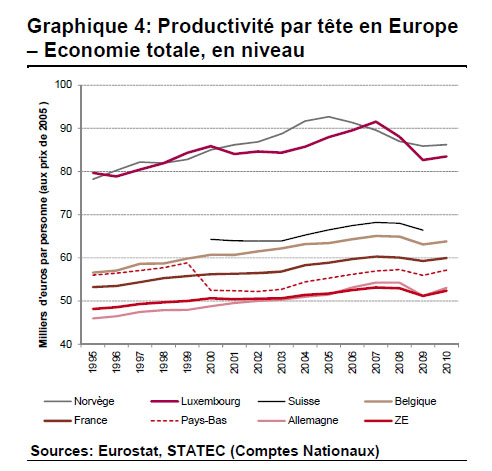
STATEC, Luxembourg's national office of statistics, has just published a comparative analysis of labour productivity in Luxembourg and the Euro area from the start of the economic crisis.
The study has revealed a larger drop in productivity in Luxembourg than in other European countries in the period between 2007-2010. One reason for this difference is the drops in activity in the finance and steel manufacturing sectors, both significant in Luxembourg's economy. Another reason for the drop in productivity is the lack of skilled labour in the Greater Region, and also that Luxembourg has traditionally had higher levels of productivity than other European countries; the economic crisis has led to a convergence in productivity between Luxembourg and other European counties.
Labour productivity is calculated as the ratio between gross value added in output volume and employment numbers.
In Luxembourg, the decline in productivity was much larger than in other countries in the eurozone. While productivity has returned to pre-crisis levels for 2010-2011 in other European countries, Luxembourg has a productivity level lower than in 2007. Since economic recovery started in 2009, overstaffing would have decreased gradually in firms, but productivity has not increased. It is clear that in 2010 and 2011, employment grew rapidly, so that productivity gains were modest and could not erase any losses observed in 2008 and 2009. Given the further deterioration of the crisis, the latest STATEC forecasts do not include a strong recovery of productivity that could be capable of reversing the losses recorded since 2009.
In the second part of the study, simulations show a more favorable development of the recent past but also in the coming years productivity would not return, before 2015, to the levels that prevailed before the crisis.