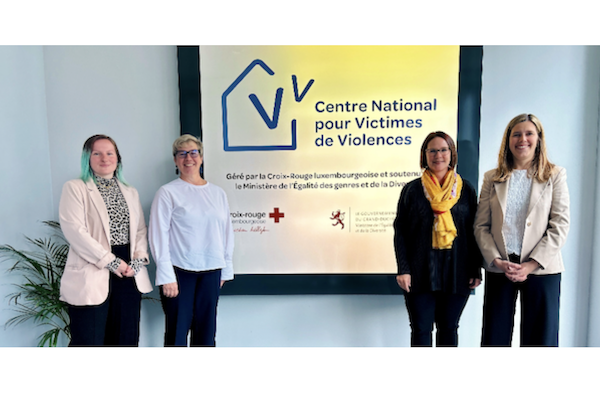
 (L-R) Ashanti Berrend, Head of the CNVV; Martine Deprez, Minister of Health and Social Security; Yuriko Backes, Minister for Gender Equality and Diversity; Elisabeth Margue, Minister of Justice;
Credit: MEGA
(L-R) Ashanti Berrend, Head of the CNVV; Martine Deprez, Minister of Health and Social Security; Yuriko Backes, Minister for Gender Equality and Diversity; Elisabeth Margue, Minister of Justice;
Credit: MEGA
On Monday 4 May 2026, the National Centre for Victims of Violence (CNVV) announced that it is now operating 24 hours a day, seven days a week, and has launched a national helpline (20601-060) for victims of all forms of violence, available continuously.
Launched in April 2025 and managed by the Luxembourg Red Cross, the CNVV was created to provide victims with emergency reception and outpatient care, accessible to all regardless of age or gender, and offering specialised support for all forms of violence. During its first year, the centre assisted 397 victims of physical, sexual, psychological or other forms of violence, highlighting the need for a centralised and coordinated support structure, according to Luxembourg’s Ministries of Gender Equality and Diversity, Justice, Health and Social Security, and Internal Affairs.
“These figures show the scale of the need. The CNVV allows victims to take a first step, at their own pace, in a safe and neutral environment,” said Ashanti Berrend, head of the CNVV.
The CNVV’s support is based on four complementary pillars, psychosocial, medical, legal and police (upon request), and relies on a broad network of partners to ensure appropriate and timely referrals.
According to the ministries, since Friday 1 May 2026, the extension to 24/7 services has been made possible by reinforcing the team with additional professionals, including social workers, educators, nurses and psychologists.
A national helpline, accessible via a single number: 20601-060, is now available at all times, offering listening, information and guidance to victims and their relatives. Staff have received specialised training from SOS Détresse to ensure professional and appropriate handling of calls.
In cooperation with the Ministry of Justice, free legal assistance is now provided through weekly legal consultations at the centre. The ministries noted that these developments reflect a clear objective: to ensure that no victim faces violence alone and to sustainably strengthen the national support system by guaranteeing maximum accessibility and high-quality care.
“A year ago, I announced that we would launch the CNVV as a pilot project and gradually develop this structure, expand our services, and strengthen the team. I am pleased to announce today that we have followed this plan and will continue to do so,” said Yuriko Backes, Minister for Gender Equality and Diversity. “With the CNVV accessible 24 hours a day, 7 days a week, we are taking a decisive step to guarantee every victim of violence immediate access to comprehensive, humane and professional care. Our message is clear: you are not alone, and help is available at all times.”
“In one year, the CNVV has concretely transformed the care provided to victims of violence. Where pathways could be fragmented, we now have a more coordinated and faster approach that fully integrates the medico-legal dimension. Thanks to better coordination with emergency services and hospitals, victims now benefit from more structured and better-adapted support,” said Martine Deprez, Minister of Health and Social Security.
“In the face of violence, our responsibility is not only to act decisively against perpetrators but also to provide victims with concrete and easily accessible support, including on the legal level. The provision of free legal assistance within the CNVV, thanks to the support of the bar and funded by the State, as well as the evolution of the legal framework in response to new forms of violence, notably cyber violence, strengthen the protection of victims,” said Elisabeth Margue, Minister of Justice.
“Making help accessible at all times is a reminder to every victim that they are never alone, at any moment,” said Léon Gloden, Minister of Internal Affairs. “No one should be assaulted. Violence has no place in our society, and we must not look away.” He added that the police are specifically trained to provide victims with the support they need.