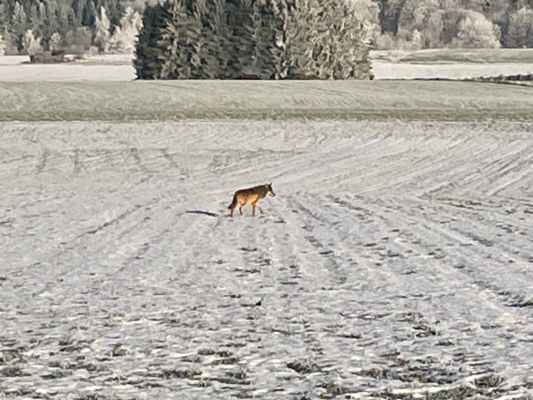
 Wolf in the Wincrange area, 11 January 2022;
Credit: PB
Wolf in the Wincrange area, 11 January 2022;
Credit: PB
On Wednesday 28 December 2022, Luxembourg's Administration de la nature et des forests reported that a dead sheep was recently discovered in a filed in the Ulflingen area, which was most likely killed by a predator.
A wolf cannot be ruled out on the basis of the initial report by experts from the nature administration. Genetic testing showed little promise as the carcass had been out in the rain for two days and secondary feeding - and hence genetic contamination - by foxes was highly likely. The area was therefore searched in detail with a dog specially trained to detect wolves. The dog reacted and barked in the manner it had been trained to detect wolf scent.
Based on the criteria used in many European countries, the incident was classified as C3: The wolf could therefore neither be 100% confirmed nor ruled out, even if it is very likely that it was actually a wolf. The sheep farmer in question was therefore compensated at 75%, as provided for in the action and management plan for dealing with wolves in Luxembourg in such cases.
The first verified evidence of a wolf in Luxembourg was in 2017 in the Holzem-Garnich area, another in 2020 in the Niederanven area, and a third in January 2022 in the Wincrange area. In addition, there was a confirmed indication in 2018 near Fouhren.
Residents are required to immediately report any indications of the presence of wolves to the nature administration for monitoring purposes (email: wolf@anf.etat.lu).
The role of wolves in the ecosystem
The wolf is strictly protected throughout Europe. It plays an important role in our ecosystems, where as a top predator it can contribute to reducing excessive hoofed game densities. In recent years, Luxembourg has been preparing for the possible return of the wolf in order to define how to deal with this species from the outset. This is done in the action and management plan for dealing with wolves in Luxembourg, which was drawn up and presented to the public together with all stakeholders from agriculture, science, nature conservation, private forest owners and hunting.
Wolves are very shy - rules of conduct in the event of an encounter with a wolf
Wolves generally avoid direct contact with humans. Encounters between humans and wolves are therefore extremely rare, but not impossible. As a rule, wolves retreat as soon as they notice a human, but they can also be curious and examine the human more closely before retreating. In addition to lots of other information about wolves, the brochure "Wolves in Luxembourg?" also explains rules of conduct that should be observed if you encounter a wolf:
- Don't run away, this can trigger the hunting instinct.
- Don't move towards the wolf. Always keep an eye on the wolf - avoiding eye contact.
- Get the wolf's attention. Shout out to him and wave your arms. If the wolf doesn't retreat immediately, back away slowly and keep a respectful distance.
- If the wolf approaches further, one should keep calling to him and throwing branches, stones or the like at him.
- Never try to lure wolves with food (not even to take photos!).
The "Wolf" action plan and the code of conduct brochure are available free of charge online and in print form from the nature administration on tel: 247-56652, as well as in the administration's visitor centres: Mirador in Steinfort, A Wiewesch in Manternach, Ellergronn in Esch-Alzette, Biodiversum in Remerschen and Burfelt near Insenborn. It can also be found online at www.emwelt.lu.