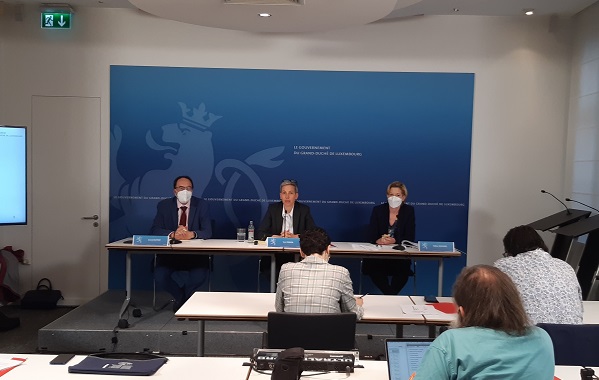
 L-R: Daniel Ruppert, Director at Directorate of Commercial Law; Sam Tanson, Minister of Justice; Hélène Massard, advisor;
Credit: MJ
L-R: Daniel Ruppert, Director at Directorate of Commercial Law; Sam Tanson, Minister of Justice; Hélène Massard, advisor;
Credit: MJ
On Tuesday 13 July 2021, Luxembourg's Minister of Justice, Sam Tanson, presented the new bill aimed at reforming the legal framework for non-profit organisations.
The goal is to create a modern framework that meets the needs of the associative and charitable sector as it stands today, on the one hand by filling in the gaps and on the other hand by clarifying and simplifying existing provisions while removing those which are no longer deemed useful.
Commenting on the bill, Justice Minister Sam Tanson said: “It was important to me not to overburden the small associations. However, we must put in place accounting and auditing obligations for large associations and foundations to meet the financial transparency requirements of the sector, also set by the FATF [Financial Action Task Force]. We modelled the accounting system on the opinions collected after the 2009 project in order to create a tailor-made accounting system. We have therefore adopted a differentiated and proportionate approach to the level of obligations by categorising associations according to a size criterion”.
With the adoption of the law, associations will no longer be obliged to submit an annual list of their members to the Luxembourg Trade and Companies Register (Registre de commerce et des sociétés - RCS). Instead, they must establish a register of members kept by the board of directors. Foundations are no longer obliged to submit and publish their provisional budget.
The procedure of homologation by the district court of statutory modifications or of the procedure of dissolution of non-profits has also been abolished.
Rules of governance are relaxed with the possibility of holding a meeting remotely or using electronic means of communication.
In addition, associations and foundations are now authorised to possess property not necessary for the achievement of their objective. According to the old legislation, non-profits were obliged to sell a bequeathed building after six months if it was not directly related to the achievement of their corporate purpose. With the introduction of this authorisation, they can continue to own these infrastructures and derive an added value from them which will be intended to finance the achievement of the social object of the association or foundation.
More specifically, the bill provides for six major changes:
- the authorisation procedure is made more transparent;
- the initial endowment of foundations is set at €100,000 with the possibility of consuming the assets without the net assets falling below €50,000;
- governance becomes more efficient by adapting the regime to technological developments and by adding certain flexibilities, such as the introduction of a legal framework for the organisation of day-to-day management or the possibility of holding board meetings and general assemblies virtually;
- new restructuring tools are expected to facilitate this by having recourse to a transformation or a merger, which will allow the non-profit to retain its legal personality in the event of a transformation and to transfer the assets and liabilities to the new or absorbing non-profit, as the case may be, in the event of a merger;
- when drafting the text, the Ministry of Justice created a tailor-made accounting system in order to guarantee transparent accounting and thus meet the requirements of the FATF recommendation VIII. Associations are categorised according to their size. Only large associations, associations recognised as being of public utility and foundations are obliged to submit their accounting documents to an approved auditor;
- an administrative dissolution procedure without liquidation has been introduced in order to have up-to-date data from the RCS necessary to meet FATF recommendation VIII.
Minister Sam Tanson concluded: “Considerable efforts are and will continue to be made to encourage associations and foundations to transmit their data within the allotted time. In order to facilitate the updating of the required data as much as possible, the LBR [Luxembourg Business Register] provides a model in order to simplify the response procedure as much as possible. Responses can be transmitted digitally. The LBR graciously offers the possibility of proceeding via the RCS assistance desk".
As of 30 June 2021, there was a total of 219 foundations and 8,281 associations registered in Luxembourg, of which 107 are considered to be public utility associations.