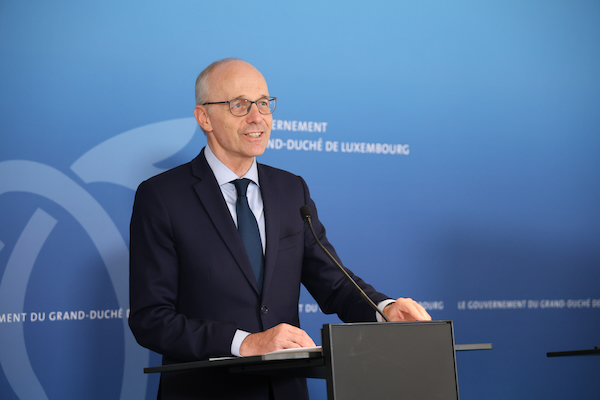
 Luxembourg Prime Minister Luc Frieden;
Credit: MAINT
Luxembourg Prime Minister Luc Frieden;
Credit: MAINT
Following the meeting of the Government Council on Friday 10 July 2026, Luxembourg Prime Minister Luc Frieden and Minister for Home Affairs Léon Gloden gave a press conference summarising the key points of the Council's work and presented legislative measures aimed at simplifying housing and urban planning regulations in the Grand Duchy.
Prime Minister Frieden began the press conference by remarking on a recent visit he had undertaken to the Technical High School where diplomas were being presenting to students. He congratulated the students on their hard work and thanked the teachers and educators for their commitment to education and remarked: “It is only when we have a good education that we will have what we need, people well prepared for the challenges of life...Thank you to the teachers and congratulations to all the students for what they have done. It is the basis of social cohesion.”
Prime Minister Frieden then proceeded to detail the work undertaken by Luxembourg's Minister Delegate to the Prime Minister for Media and Connectivity, Elisabeth Margue, in relation to the findings of the Luxembourg Media Pluralism Monitor and the implementation of legislation to allow greater access and transparency of information for journalists in Luxembourg.
He said: “We need a pluralist press and we need state support and its financial means are defined in a clearer way in this text. So access to information for journalists is anchored by the law and we hope that it is in the sense of transparency and strengthening democracy.”
The Prime Minister then moved on to the subject of the recent Tripartite Agreement and the context of aid to farmers, and announced that the government has ensured that it can provide urgent aid to farmers to compensate for their additional costs, particularly in relation to rising cost of fertilizer as a result of the conflict in Iran.
He then touched on the subject of the National Building Regulations and Simplification of PAP/PAG Procedures, aimed at focusing on the modernisation and simplification of national building regulations, to create a harmonised, coherent, resilient and future-oriented regulatory framework. Prime Minister Frieden stated: “I know that for our citizens, housing is a very important issue and it is very satisfying to see what is being done. We are convinced that in the case of the implementation of our ten-point plan, that in particular a lot of affordable housing will be realised.”
Additional subjects covered by the Prime Minister also included the government’s focus on renewable energy, the hiring of 500 additional police officers to bolster security and he announced that Benoit Elvinger will become Director General of the Treasury from Thursday 1 October 2026.
Prime Minister Frieden also revealed that although the Grand Duchy current commits to 2% spending on its NATO commitments, it will gradually increase this by an additional 0.1% or 0.2% next year.
Minister Gloden then presented the measures aimed at simplifying procedures relating to general development plans (PAG) and special development plans (PAP).
He remarked: “In future, a single building regulation will apply to all 100 municipalities in the country…This represents a paradigm shift.”
Designed with a focus on modernisation and simplification, the national building regulations will provide a harmonised, coherent, resilient and future-oriented regulatory framework. According to Minister Gloden, they are design to ensure greater clarity for the construction sector, accelerate construction and enable municipalities to implement sustainable urban planning solutions.
Minister Gloden stated: “The national building regulations pay particular attention to new climate realities, notably the increasing frequency and intensity of heatwave events...With regard to the development of public spaces, concrete measures are planned to reduce heat islands, improve comfort and, therefore, quality of life.”
According to the Ministry for Home Affairs, the implementation of the “More with less” principle will result in the following benefits:
• Better quality of life
• More renewable energy
• Greater resilience
• More time for architectural and urban planning quality
• Greater legal certainty
Included in the coalition agreement, the national building regulations constitute one of the 40 measures in the government package, selected on the basis of proposals made by a working group established following the national housing meeting at the beginning of 2023. The aim is to build more and faster – “Méi a méi séier bauen”. The draft national building regulations and the simplification of PAP/PAG procedures form part of the administrative simplification measures that are a priority for the government. The coalition agreement aims to remove administrative burdens where they do not provide added value to society and quality of life. The energy freed up as a result can then be reinvested in the planning and creation of housing and attractive living spaces.
“Each measure is designed to enable more and faster construction, while ensuring high standards of urban planning quality and quality of life,” stated Léon Gloden.