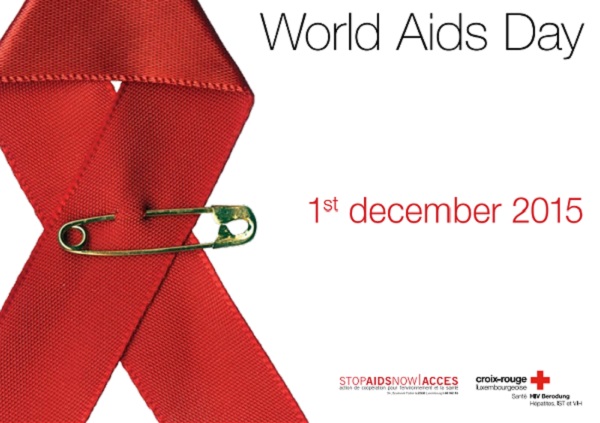
On Tuesday 1 December 2015, Luxembourg joined countries around the globe in recognising the annual World AIDS Day, with information, prevention and awareness campaigns and remembrance of the deceased whose lives were taken by the disease.
World AIDS Day is held every year worldwide on 1 December, but this year also took place under the aegis of the 'Fast Track' strategy of UNAIDS, which aims to accelerate the elimination of the AIDS epidemic as a threat to public health by 2030, as is held in the Sustainable Development Goals (SDGs) of the 2030 agenda. With the European Region of the World Health Organisation (WHO) recording the highest number of new HIV cases in 2014 since the beginning of data collection, the fight against this disease is still a significant struggle.
The fight against AIDS has encountered remarkable successes and today almost 16 million people with HIV have access to antiretroviral therapy throughout the world. The goal of the global campaign 'Treatment 2015' to provide this to 15 million people by 31 December 2015 was already attained in spring of this year and almost half of those in need are now receiving treatment. Antiretroviral therapy enables people with HIV to live healthy lives but also contributes to the prevention of HIV transmission, especially for groups and individuals at risk.
In the last 15 years, the number of new infections has fallen by 35%, standing at 2,000,000 in 2014, and the number of AIDS-related deaths has fallen by 25% to 1.2 million. 73% of pregnant women have access to services which eliminate mother-to-child transmission, meaning that new infections in children has been reduced by 58%. However, despite these decreases these figures still remain high, and much remains to be done in the fight against HIV among children regarding paediatric ARV treatments and diagnostics, with only 32% of children in need of treatment actually able to access it.
In 2014, in some countries of Central and Eastern Europe, cases of HIV more than doubled. Men engaged in same-sex or bisexual relationships were found to be the most affected, followed closely by people injecting drugs intravenously. In Luxembourg, 96 new people were found to be HIV-positive in 2014. Up until 25 November 2015, 78 new patients were recorded, of which 54 were men and 24 were women. Although this represents a decline from the previous year, the infection rate remains at a high level.
Although drug consumption centres exist in Luxembourg to avoid the sharing of needles and the transmission of diseases, the increase of new infections among injecting drug users was said to be significant.
Currently, about 1,000 people live in Luxembourg with HIV, with 25% unaware of their HIV status, making it essential to develop awareness campaigns and spread messages of prevention and protection, by encouraging the use of condoms and early detection through HIV tests.
Luxembourg contributes to the fight against AIDS by providing support to relevant international organisations in the field (WHO, Global Funds, UNAIDS) as well as through national and international NGOs, such as ENDA-Santé, which is based in Senegal and works in collaboration with the Luxembourg NGO Stop Aids Now/Access in the West African region.
This month the Global Fund is launching its 5th replenishment campaign covering the period from 2017 to 2019 and the financial needs to end the fight against AIDS remain in the billions. In recent years there has been a huge increase in domestic investment in developing countries, with more than half of the funds today coming from national sources.
As HIV affects disproportionately vulnerable groups and leaves them feeling stigmatised and excluded, the Luxembourg Ministry of Health this year targeted the discrimination and stigmatisation of HIV in the workplace, with a focus on irrational fears of potential contamination and prejudices about the modes of transmission. The Ministry aimed to inform and encourage human and professional relationships between colleagues. Modern medicine has enable people with HIV to enjoy a good quality of life and have an almost normal life expectancy, yet discrimination and stigma remain a threat for which the only remedy is information, speaking, listening and mutual respect.
Yesterday morning, volunteers from Stop Aids Now/Acces handed out condoms at Luxembourg Gare to remind passers-by that such a contraceptive remains an important way of avoiding infection. At midday, the DIMPS then offered a free and anonymous HIV test to the public. The Ministry of Health then held a solidarity evening, where Luxembourgish artists reproduced their pieces in silkscreen and sold them to raise money for Stop Aids Now/Acces and the HIVberodung service of the Luxembourg Red Cross.