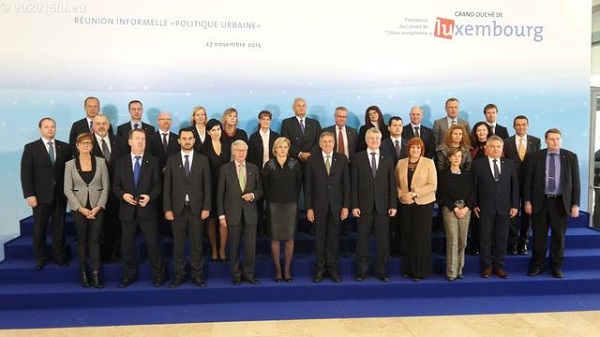
On Thursday 26 and Friday 27 November 2015, the informal ministerial meetings on Territorial Cohesion and Urban Policy took place, at which ministers discussed how to maintain balanced development opportunities on the European Territory.
It was agreed by the ministers present that decreasing European cohesion in multiple fields is seeing integration in the region come under pressure. One of the most apparent consequences was cited as the uneven response to the migration crisis. The lack of cohesion has hit certain countries more than others and at the regional level effects were said to be multiplying. The financial and economic crisis has reinforced this tendency, and loss of territorial cohesion culminates in a lack of opportunities for economic activities and creates dissatisfication with personal situations. More severe consequences can be outmigration and depopulation, concentration of economic activities, congestion and pollution.
"We would like to employ territorial scenarios to better understand what kind of territorial challenges we will face in the future and what we can already do today to avoid them," commented Luxembourg Minister of Sustainable Development and Infrastructure, François Bausch. "Maps and territorial visions can say more than a thousand words. Sector policies are often not aware that their decisions have a territorial impact. We must visualise these impacts to stay in touch with sector politices and demonstrate that territorial cohesion matters."
"We need to have a new vision of how Europe should grow; first, every citizen should enjoy a good quality of life wherever he or she decides to live in the EU," added Commissioner for Regional Policy, Corina Creţu. "To this end we need to identify the obstacles that cross-border regions face in order to work together on overcoming them. Then, I believe EU policies and investments should further take into account the diversity of urban areas across the EU. This is why our discussions focused on how to boost growth and job creation in every regions and cities of Europe, addressing specific challenges and definining common goals."
President of the European Committee of the Regions, Markku Markkula, pointed to the fact that more than one-third of the EU population is living on borders, stating "From migration to economic growth to the urban agenda, we have shared challenges that transcend borders. But strengthening cross-border cooperation needs simpler EU laws to attract further investment. Regional and local authorities can support this process by working to harmonise administrative procedures. Member states need to also show more political will in this field and redouble efforts to expand the EU legal tool - European Grouping of Territorial Cooperation."
By contrast, ministers were of the opinion that Europe is growing together, stating the gaps remained at the border due to differente technical standards such as for transport systems or diverging rules and laws for hospitals or fire brigades which prevent the use of such services in full by citizens across the border. The management and cooperation of cross-border policies is of particular importance for Luxembourg, both in terms of its status as a small country and as a founding member of the EU.
In terms of Urban Policy, ministers looked at small and medium sized cities in Europe with a view to promoting a polycentric development in order to ensure good living and working conditions for the citizens all over Europe. Those present used the Greater Region as an example for under-used development potential still hiding in cross-border regions which should be activated to the benefit of all of Europe.
The urban dimension of the refugee situation was also discussed. Refugees are focusing on cities as point of arrival and in return cities are often responsible for providing housing, and ensuring subsistence not only in the short term like an emergency situation but also in the mid and long term as a structural issue with wide-ranging and long-term repercussions for almost all policy areas. Ministers finally informed those present of the progress made regarding the European Union Urban Agenda which will be agreed under the Dutch Presidency.
Photo by eu2015lu.eu