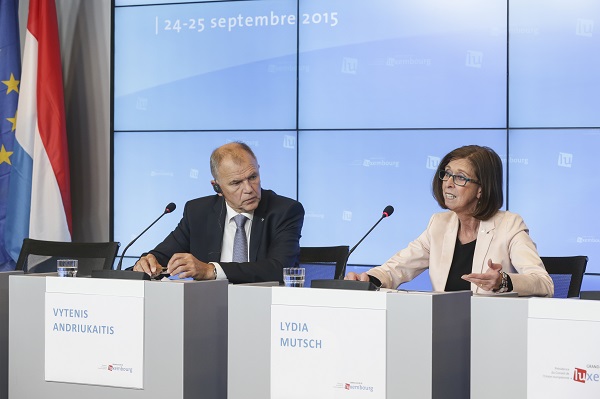
Dementia prevention, health in migration, the risks in trans fat consumption and cross-border healthcare were all at the heart of discussions at the informal meeting of Ministers of Health on 24 and 25 September 2015.
In July, the Luxembourg Presidency cited dementia prevention and practices to support people with dementia as one of its priorities in the health sector.
"This is a real socio-economic challenge which is straining the sustainability of our health system," said Luxembourg Minister of Health, Lydia Mutsch, at last week's meeting. "That is why we have approached dementia as a societal phenomenon, which requires multi-sectoral responses".
The Ministers present agreed that an adjustment to policies and prectices was called for in order to improve the care for each person suffering from dementia, declaring it a goal to destigmatise this mental illness, invest in research, adapt the role and training of health professionals and ensure adequate support for patients and their families.
In order to achieve this, an exchange platform of good practices between Member States and the Commission has been proposed, within existing forums at the EU and the World Health Organisation (WHO) - a concept which has been met with wide acclaim.
One such example is the 'Dementia Prevention Programme' (PDP), established by Luxembourg in June, which aims to use new diagnostic methods to recognise dementia symptoms at an early stage and subseqeuently put preventative measures in place.
"I believe that the time has come to strengthen our collaboration - a major challenger that we all must face - by focusing on the prevention of risk factors; early diagnsis and adequate post-diagnostic care for every person affected," commented Vytenis Andriukaitis, European Commissioner for Health and Food Safety. Conclusions concerning dementia will be adopted at the December Council.
The Ministers also spoke of the need to better address the public health dimension of the current refugee crisis, unanimous in the point of view that the impact of migration on health systems in Member States could not be denied.
Referencing the crisis which has now engaged all of Europe, the Ministers emphasised the importance of equal access to health systems for refugees and migrants, as well as the necessary strengthening of the capacity of health infrastructure in order to better manage the flow of refugees.
"We must not miss the opportunity to cooperate in order to achieve a sound and responsible migration policy which addresses all dimensions of this crisis and respects our common values!" affirmed Minister Mutsch.
The Commissioner spoke of the €73 million investment from the European Commission towards the enhancement of the reception capacity, as well as joint efforts to inform Member States of existing tools and funds in order to facilitate the access of refugees to health systems. Commissioner Andriukaitis then encouraged Member States to assert their needs in the financial and technical support offered at EU level.
Talks then continued on to an examination of the impact of the Directive on cross-border healthcare, which was transposed two years ago.
"Every citizen of the EU is a potential patient able to claim appropriate, quality and timely healthcare," continued Lydia Mutsch. "In some cases, these treatments are on the other side of the border".
The Grand Duchy has experienced a long tradition of cross-brder healthcare and cooperation in this respect with its neighbouring countries, and constituted the leading country with a high flow rate of discharged patients.
As Lydia Mutsch explained, "Knowing the nature of the cross-border flow of patients and the reasons that lead patients to seek treatment abroad helps to make the right political choices".
This point was further emphasised by Vytenis Andriukaitis, who stated that: "The first report from the implementation of the Directive shows significant progress in legislation at the EU level. However, efforts still remain to be done to ensure the full potential of the Directive".
The Ministers agreed that in order to ensure equal access to high quality healthcare for citizens and to improve patient mobility, patient information and close cooperation between Member States, particularly in the field of rare diseases and eHealth, were called for.
Lastly, the group exchanged views on measures that could be taken to ensure better information for citizens concerning the presence of fatty acids in food, which often cause cardiovascular disease. Whilst opinions differed regarding the voluntary or compulsory nature of such procedures, the Ministers were united in requesting that the Commission publish a report on the content of these acids in food as soon as possible.
Photo by eu2015.lu/Luc Deflorenne (L-R: Vytenis Andriukaitis, European Commissioner for Health and Food Safety; Lydia Mutsch, Luxembourg Minister of Health)