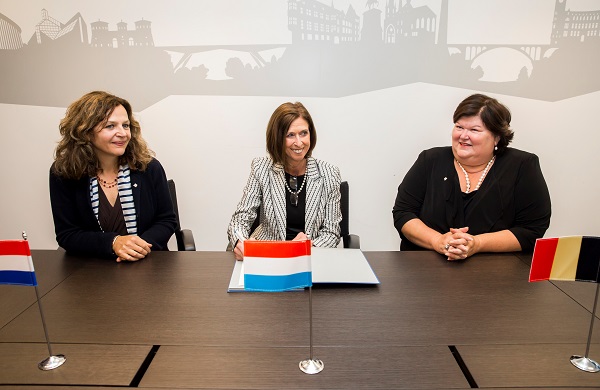
On Thursday 24 September 2015, Minister of Health Lydia Mutsch and Minister of Social Security, Romain Schneider, signed a declaration of intent which will see the Grand Duchy join a Belgian-Dutch collaboration concerning orphan drugs.
The three countries will join forces in negotiating with pharmaceutical companies to keep prices down for orphan drugs, the pharmaceutical agents used to specifically treat a rare medical condition.
"The high level of drug prices is increasingly shaping our thoughts on access to hgih quality care to benefit our citizens, especially those with a rare disease," explained Minister Mutsch. "I am convinced that this new collaboration with our Belgian and Dutch partners will be an important step to tackle pragmatic solutions together and with a constructive approach."
"Our budgets are put under strain by the cost of drugs," added Minister Schneider. "The knowledge and experience gained in this area by Belgium and the Netherlands will allow Luxembourg to take advantage of valuable expertise".
A joint approach to this issue was first discussed by Belgium and the Netherlands in December 2014 and, on 20 April 2015, the Dutch Minister for Public Health, Edith Schippers, and her Belgian counterpart, Maggie De Block, signed a declaration of intent to collaborate towards pharmaceutical reimbursement of orphan drugs.
The initiative will be followed by the development of practical conditions for the launch of an initial pilot project, and it is expected that in the future the three countries withh exchange data and records in order to coordinate their evaluation methods.
Orphan diseases are defined by their rarity, affecting less than five hundred thousand people. There are currently about 8,000 orphan diseases for which only 150 medicines are available on the market, with an estimated 30 million Europeans suffering from one of these 8,000 orphan diseases.
It is their very infrequency which causes issues for orphan disease sufferers, as a firm may sell only a few doses of an orphan drug at a very high price. By countries joining forces, they are able to represent more patients and thus establish the conditions to negotiate lower prices.
Pharmaceutical companies would also benefit from the initiative, as it would mean the introduction of a single record and would allow them access to a larger number of patients. Several of these companies have picked up on this, indicating that they would like to join the pilot project.
"This is a step towards a more broadly shared European approach to orphan drugs," commented Belgian Minister for Public Health, Maggie De Block. "Last year, each county was still alone. Today, we are already three, jining forces in order to provide the best care to our patients with rare diseases".
Photo by eu2015/Julien Warnand (L-R: Edith Schipper, Minister of Health, Minister of Wellbeing and Sports of the Netherlands; Lydia Mutsch, Minister of Health of Luxembourg; Maggie De Block, Minister of Social Affairs and Public Health of Belgium)