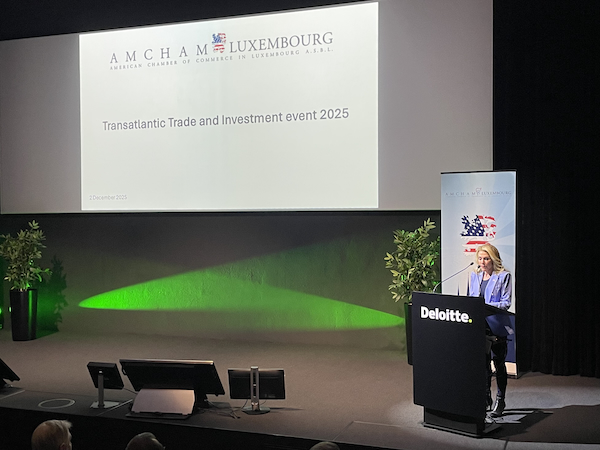
 US Ambassador to Luxembourg Stacey Feinberg;
Credit: Steven Miller, Chronicle.lu
US Ambassador to Luxembourg Stacey Feinberg;
Credit: Steven Miller, Chronicle.lu
On Tuesday 2 December 2025, the American Chamber of Commerce in Luxembourg (AMCHAM) together with Deloitte, held an event dedicated to "Transatlantic Trade and Investment", which included the presentation of the 2025 Annual Transatlantic Trade analysis data papers.
Speakers at the event, which took place at Deloitte in Cloche d'Or, were: CEO of Deloitte Luxembourg, John Psaila; AMCHAM Chairman and CEO, Paul Schonenberg; US Ambassador to Luxembourg Stacey Feinberg; Luxembourg Ambassador in Washington Nicole Bintner-Bakshian (via video message); and Director of Public Affairs at AmCham EU in Brussels, Thibaut l’Ortye.
Francisco da Cunha opened the evening event by welcoming the United States Ambassador and guests on behalf of Deloitte. He spoke of the importance of transatlantic trade in enabling economic growth on both sides of the Atlantic and the importance of the role of AMCHAM in facilitating the relationship between the United States and Luxembourg. He highlighted that trade between the US and Europe represented the second largest free trade zone in the world and emphasised the global importance of the relationship, as well as the shared values between the Luxembourg and the United States.
He said: “Transatlantic relations do not thrive solely on statements. They rely on trust, on openness, on the discipline of meeting people together with a purpose. […] Tonight offers us a moment to reflect on a relationship that continues to underpin global economic stability.”
Paul Schonenberg spoke of both the historic and current contribution American businesses make in Luxembourg and the significance of the United States as Luxembourg’s fourth largest trading partner. He also noted the influence of Luxembourg on the US through the migration of Luxembourg nationals in the 19th century which accounts for over two million people of Luxembourgish descent living in the US. He then provided detail on the background of AMCHAM chambers across Europe and how they work together to analyse transatlantic trade, with seven of those, including Luxembourg, funding the annual report that was carried out by Daniel Hamilton and Joseph Quinlan, from the Foreign Policy Institute of the School of Advanced International Studies at Johns Hopkins University and the Transatlantic Leadership Network.
He then introduced Ambassador Feinberg who spoke of the success of Luxembourg’s relationship with the US and its ability to “punch above its weight class”, highlighting the Grand Duchy’s development of emerging technologies in areas such as artificial intelligence (AI), fintech, cybersecurity, space, satellites and autonomous driving. She said: “Our countries have a lot in common. Luxembourg's highly favourable tax policies, business-friendly environment and its status as a global financial centre makes it especially attractive for foreign direct investment.”
She added: “I want Luxembourg to be the entry point for US firms to get into the European market. And I want Luxembourg to look to the United States as their natural partner for doing business to help create jobs on both sides of the Atlantic.[…] My team and I are here to make that happen and we look forward to working with all of you to advance these shared goals. Let's make it happen.”
Nicole Bintner-Bakshian then contributed to the event via a pre-recorded video. She thanked AMCHAM for its work in maintaining and developing the relationship between the two countries and welcomed Ambassador Feinberg to her new position. She then noted how Luxembourg’s trade volume with the US has doubled within the last ten years and how in 2024 this represented around one third of the Grand Duchy’s GDP.
She said: “Luxembourg is proud to serve as an important gateway to Europe for many American companies, some of which have been here for a very long time, and many of which are in the room tonight. Looking ahead, Luxembourg is determined to remain a partner of choice for US companies. In an era where the pace of change outstrips our expectations, the relationship between our two countries reminds us of something essential, that when nations trust and invest in each other, they spark innovation, fuel growth and unleash the tension. It is more than just economics and trade. It is about creating a world where partnership drives progress and unity becomes the strongest currency.”
Thibaut l'Ortye then presented the 2025 Annual Transatlantic Trade analysis data. He first underscored the importance of the recently established framework agreement between the EU and the US, the strength of the EU single market as the biggest driver of foreign investment into Europe and the significance of Luxembourg geographically in providing US companies with access to Europe.
A short video then detailed the value of US-Europe trade, with 64% of global investment into the US originating from Europe and 56% of US global investment between 2009 and 2023 going to Europe. In terms of trade in goods, the US-EU relationship brought in $504 billion to Europe and sent $771 billion to the US, with $7.5 trillion in total commercial sales a year. In terms of purchasing power, the transatlantic economy represents one third of global GDP.
Thibaut l'Ortye noted: “That is what this relationship is worth and it is the largest commercial relationship in the world.”
He then spoke of the impact of the Presidency of Donald Trump, noting its influence on EU-US trade negotiations and the initial uncertainties his tariff policies raised in the first part of the year. He also highlighted the importance of the simplification in EU regulations to enable the economic relationship to thrive and the significance of the role Europe plays in this.
He said: “If we want to make sure that the transatlantic economy grows, we actually have to start, and I am saying this as a European voice as well, we have to start the work at home. This relationship can only be strong if Europe's economy is strong. And so, the conversation that is going on in Brussels, but also in European capitals, around competitiveness is essential.”
In conclusion, he said: “We have talked about bridge building a few times already this evening. I think that is our role. It is really to make sure that we build on this $9.5 trillion relationship. We have a deal that has brought some stability. It is our responsibility to make sure that we add to this deal and ultimately find a way to grow this relationship that is the most consequential in the world.”
There then followed a brief questions and answer session before the event concluded with a networking cocktail.