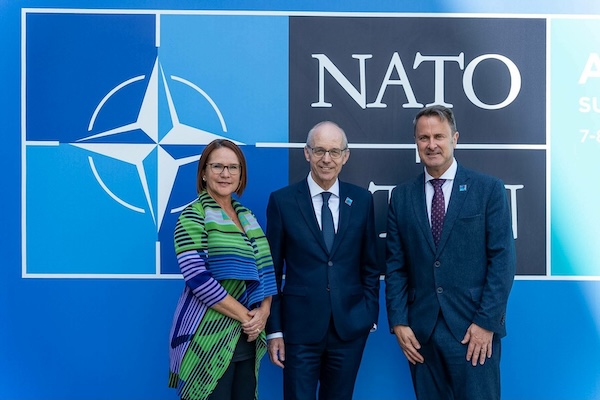
 (L-R) Yuriko Backes, Luxembourg's Minister of Defence; Luc Frieden, Luxembourg's Prime Minister; Xavier Bettel, Luxembourg's Deputy Prime Minister and Minister for Foreign Affairs and Foreign Trade;
Credit: ME
(L-R) Yuriko Backes, Luxembourg's Minister of Defence; Luc Frieden, Luxembourg's Prime Minister; Xavier Bettel, Luxembourg's Deputy Prime Minister and Minister for Foreign Affairs and Foreign Trade;
Credit: ME
From Tuesday 7 to Wednesday 8 July 2026, Luxembourg's delegation, including Prime Minister Luc Frieden, Deputy Prime Minister and Minister for Foreign Affairs and Foreign Trade Xavier Bettel, and Minister of Defence Yuriko Backes, participated in the NATO Summit in Ankara, Turkey.
According to Luxembourg's Ministry of State, the Ministry of Foreign and European Affairs, Defence, Development Cooperation and Foreign Trade, and the Directorate of Defence, political leaders of the Alliance discussed NATO's political direction, focusing on transforming the financial commitments made at the Hague Summit into military capabilities and forces that strengthen the Alliance's deterrence and defence posture.
The ministry noted that, in this context, Prime Minister Luc Frieden stressed the importance of solidarity among Allies while supporting the ambition of a stronger European pillar within a stronger NATO.
President Volodymyr Zelensky also took part in the summit, during which the Allies reaffirmed their support for Ukraine, its sovereignty, territorial integrity, international law and its right to self-defence.
Faced with an increasingly unstable global environment, the Allies committed to continuing investments in defence capabilities, the defence industry and innovation, which they described as key elements of collective security in the Euro-Atlantic area.
The ministry reported that Luxembourg, together with Canada, proposed the creation of the Defence, Security and Resilience Bank (DSRB), a multilateral financial institution aimed at mobilising private capital to strengthen common security through investment in the defence industry.
At the NATO Summit in Ankara, nine countries - Albania, Belgium, Canada, Greece, Latvia, Luxembourg, Romania, Türkiye and Ukraine - pledged to support the initiative. Prime Minister Frieden also presented the proposal during a roundtable discussion at the NATO Summit Defence Industry Forum (NSDIF) on Tuesday 7 July.
As reported by the ministry, Prime Minister Frieden stated: "Unity is strength. Greater specialisation among countries would benefit both the Alliance and each Ally. Luxembourg, for its part, could contribute even more in the fields of finance and space for the benefit of our collective security."
The ministry added that Deputy Prime Minister Bettel participated in a working session with partners of the Istanbul Cooperation Initiative (ICI), attended by representatives of Bahrain, Kuwait, Qatar and the United Arab Emirates.
Minister Bettel also took part in the NATO-Ukraine Council, where he reiterated Luxembourg's support for Ukraine, stating: "It is essential that Ukraine is in the strongest possible position when peace negotiations take place. The support of NATO members is crucial in this regard."
During a working dinner of NATO defence ministers, also attended by their counterparts from Australia, Japan, New Zealand and South Korea, Minister Backes stated: "Luxembourg will fully assume its share of the collective defence burden by contributing forces and investing in new state-of-the-art military capabilities."
At the NSDIF, Minister Backes participated in a ceremony announcing and signing several multinational NATO programmes, including:
- Finland's accession to the Multinational Multi-Role Tanker Transport (MRTT) Unit and the announcement of the forthcoming delivery of the unit's tenth MRTT aircraft;
- the announcement of Saab's new GlobalEye platform to replace NATO's ageing AWACS fleet under the initial Alliance Future Surveillance and Control (iAFSC) programme;
- Luxembourg's accession to NATO's Defence Critical Raw Materials high-visibility project, aimed at strengthening the resilience of defence supply chains across the Alliance.