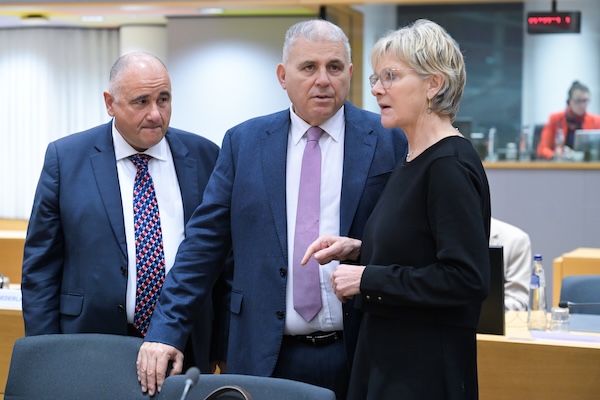
 (L-R) nc; Anton Refalo, Malta’s Minister for Agriculture, Fisheries and Animal Rights; Martine Hansen, Luxembourg's Minister of Agriculture, Food and Viticulture;
Credit: © Sophie Hugon / EU
(L-R) nc; Anton Refalo, Malta’s Minister for Agriculture, Fisheries and Animal Rights; Martine Hansen, Luxembourg's Minister of Agriculture, Food and Viticulture;
Credit: © Sophie Hugon / EU
Luxembourg's Minister of Agriculture, Food and Viticulture, Martine Hansen, participated in the EU Agriculture and Fisheries Council in Brussels, Belgium, on Monday 26 January 2026.
As reported by Luxembourg's Ministry of Agriculture, Food and Viticulture, the Cypriot Presidency presented its work programme and priorities for the first half of 2026. The ministers held exchanges on several key agricultural and food-related issues, including pesticide residues in foodstuffs, organic farming, origin labelling and the future of the Common Agricultural Policy (CAP).
Following farmers’ protests in December, the ministry reported that Commissioner Olivér Várhelyi presented a legislative package aimed at redefining import tolerances for residues of plant protection products not approved in the EU. In this context, the European Commission announced the deployment of a task force to strengthen controls at the EU’s external borders.
The ministry added that Minister Hansen welcomed this revision, describing it as “important to guarantee healthy food for our consumers and fair competition for our farmers”. She underlined that in Luxembourg, the ALVA takes import controls very seriously and noted that, over the past three years, 35% of imported and registered fruit and vegetables have been subject to residue analysis. Luxembourg supports the creation of a harmonised EU-wide control task force, as well as audits in third countries of food safety systems.
The ministers also exchanged views on the follow-up to the political meeting of European agriculture ministers held on 7 January. In this context, the ministry said that Martine Hansen recalled the need for the CAP to be accompanied by an ambitious dedicated budget in order to ensure Europe’s food sovereignty.
The Council also held a policy debate on a proposal to revise the regulation on organic farming, following a recent ruling by the European Court of Justice. Minister Hansen supports the ruling, which clarifies that the EU organic logo may only be used for products that fully comply with European production standards. She proposed additional simplifications, including greater flexibility for mixed grazing of animals on organic pastures and for soil fertilisation methods in greenhouse production.
On the issue of origin labelling, Martine Hansen favours a pragmatic approach. She stated: “Consumers are increasingly interested in food quality and origin. Origin labelling allows our farmers to add value to their products, but it also places significant constraints on the processing sector. That is why, for composite foodstuffs, we propose simpler EU/non-EU labelling, which meets the demands of our farmers.”
On the sidelines of the Council, the ministry said that Martine Hansen met her French counterpart, Annie Genevard, Minister for Agriculture and Food Sovereignty. The two ministers share the conviction that as many import tolerances as possible for residues of unauthorised substances should be abolished as quickly as possible, particularly those posing a potential risk to consumers. Minister Hansen also discussed France’s experience in managing the contagious nodular dermatitis crisis.
Finally, the ministry added that the two ministers exchanged views on the future of the CAP, reaffirming their commitment to a strong and common policy supported by a coherent and autonomous regulatory framework.