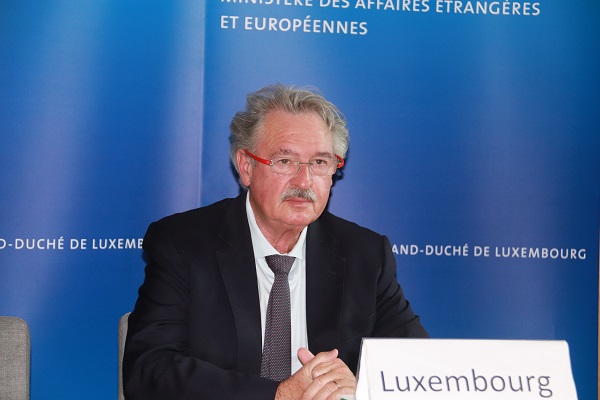
 Jean Asselborn, Luxembourg's Minister of Foreign and European Affairs;
Credit: MAEE
Jean Asselborn, Luxembourg's Minister of Foreign and European Affairs;
Credit: MAEE
On Monday 15 March 2021, Luxembourg's Minister of Foreign and European Affairs, Jean Asselborn, participated in the informal joint meeting of the Foreign Affairs and Justice and Home Affairs Councils of the European Union (EU), which was held via videoconference.
This joint meeting, which brought together European foreign ministers and ministers in charge of migration, enabled an in-depth exchange of views on the external dimensions of the EU's migration policy within the framework of the new Pact on Migration and Asylum.
The ministers notably addressed the issue of migration in the framework of bilateral relations with the main third countries, as well as the means to be found to strengthen cooperation and coordination between EU countries, institutions and agencies.
Minister Jean Asselborn began his intervention with the following observation: "Our partners in the south and in the east will not be able to resolve our internal problems on migration, neither in terms of European responsibility, nor in terms of European solidarity". He added: “As far as the European Union's migration policy is concerned, there has been no change of paradigm, nor even the beginning of a change in attitude since 2015".
Luxembourg's Foreign Minister deplored that the EU "continues to block and procrastinate" in the face of the question of measures to share the "burden" to come to the aid of Member States at the borders.
Regarding the tools and political instruments available to the EU in the context of its bilateral relations with partner countries, Minister Jean Asselborn stressed that “betting unilaterally on return and readmission will not work, just as it did not work in 2015”.
Luxembourg's Foreign Minister also looked at another instrument, which was already on the table in 2015, namely legal migration. In this regard, he welcomed the European Commission's proposal for a “talent partnership” and spoke in favour of more generalised legal migration, which the EU needs to close the demographic gaps in the medium term in many Member States.
As for relations and cooperation with Turkey in the context of migratory flows, Minister Jean Asselborn estimated that financial aid (as support for more than three million refugees in Turkey) is justified. “It would be counterproductive to stop it. It is aid to refugees and not to the authorities”, he pointed out.
For its part, the Portuguese Presidency of the Council of the EU concluded that the EU will mobilise all the tools at its disposal to achieve tailor-made partnerships with priority third countries.