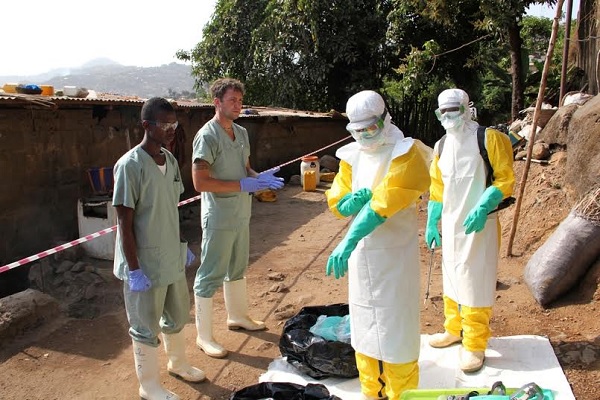
Sixteen months after humanitarian aid organisation Médecins Sans Frontières (MSF) first responded to the Ebola epidemic in West Africa, the Luxembourg branch of the association has claimed that the nightmare is still not over in Guinea, Sierre Leone and Liberia.
According to MSF, there have so far been more than 27,678 people infected by the disease and 11,276 subsequent deaths. In the last eight weeks, the number of cases in the region reportedly stagnated to around 30 new infections a week, which MSF claims woulds be considered a disaster under normal circumstances.
The organisation has previously been vocal in its condemnation of the degree to which the international community was willing to get involved in the Ebola outbreak, stating that the lack of support on the ground was a 'betrayal' to the populations of West Africa and the aid teams in the field.
"We saw so many reportd calling for change, with everyone focusing on a way to improve futures responses to epidemics and meanwhile, new cases of Ebola continue to emerge every week in the region," commented International President of MSF, Joanne Liu. "We still do not have the epidemic under control. With this Ebola epidemic, we went from overall indifference, to global panic before finally arriving at international response, but now we are facing a global exhaustion of teams on the ground and affected communities. We must finish the job!"
In Guinea, active transmission channels persist in Conakry, Boke and Forecariah. Boke is located in northern Guinea, near the border with Guinea Bissau, and represents an area where MSF is assisting local authorities to prepare a response plan in the event that Ebola cases are found in the country.
"We still find 12 to 18 Ebola cases each week in Guinea," explained Anna Halford, who is an emergency coordinator for MSF in Guinea. "The cases remain undected for too long. In the past three weeks, a quarter of positive cases have been identified after the death of a patient in the community."
On 3 July 2015, MSF opened an Ebola care centre in Boke and in Conakry, MSF continues its activities within the community to combat the lesser known dangers of rumours, fears and weariness.
"We know that everyone is tired," continued Halford. "The national authorities continue to work on Ebola and just want the epidemic to end. After a year of response to the epidemic we are tired too, but the epidemic is not over and we cannot let it go until we reach zero cases."
The Western Area, Port Loko and Kambia districts of Sierra Leone represent another area in which the outbreak continues to spread. In the Freetown region of the Western Area, the number of cases peaked at ten, signifying the largest number since March. MSF reported that it has continued its awareness activities in Freetown and the monitoring of potentially affected people, the latter of which MSF activities coordinator Jose Hulsenbeck explained was of utmost importance.
"It is essential to maintain contact with people who might be sick," said Hulsenbeck. "Close relationships with the community are essential in order to break the chains of infection.
"The restoration of healthcare in Sierra Leone will not just be concluded at the end of the Ebola epidemic," continued Hulsenbeck. "In response to the epidemic, the country was already severely lacking in qualified health personnel. And 220 health professionals have died from the virus, making needs even more pressing."
MSF also made reference to the devastating news that new cases had been found in Liberia - a country where the epidemic had initially been declared to be over.
"It's disappointing, of course, but not surprising," stated Carissa Guild, a member of the MSF Liberia medical team. "The risk of new infections was always there once there were cases in the region."
MSF added that it would remain on hand ready to assist the Liberian Ministry of Health in the fight against the epidemic, and that in Monrovia it has established and begun to manage both a children's hospital and a clinic for survivors.
Luxembourg has continued to support the Médecins Sans Frontières organisation in recent months, through charity auctions, pop-up stores and international bazaars. In its 2014 report, MSF thanked its benefactors within the Luxembourgish community who donated an overall €6.2 million to the MSF project fund.
Photos by MSF