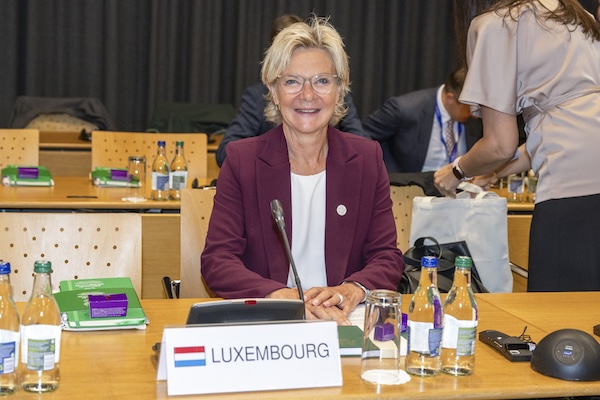
 Martine Hansen, Luxembourg's Minister of Agriculture, Food and Viticulture;
Credit: Michael Chester / UE
Martine Hansen, Luxembourg's Minister of Agriculture, Food and Viticulture;
Credit: Michael Chester / UE
On Monday 7 and Tuesday 8 September 2026, Luxembourg's Minister of Agriculture, Food and Viticulture Martine Hansen participated in the informal meeting of EU agriculture and fisheries ministers in Dublin, Ireland.
According to Luxembourg’s Ministry of Agriculture, Food and Viticulture, the discussions focused on the role of research and innovation in the new European strategy for sustainable livestock farming and the European action plan for proteins, which Minister Hansen described as "key tools for the agricultural sector".
Against a backdrop of drought and rising input costs affecting livestock farmers, the ministry noted that research and innovation could serve as strategic tools for combining economic performance with the ecological transition.
Minister Hansen stressed the importance of finding alternatives to reducing livestock numbers as the sector works towards methane and ammonia reduction targets, noted the ministry.
"We have high ambitions for reducing methane and ammonia. If we do not want to choose the easiest solution, i.e. reducing livestock numbers, we need scientific and applied research to find appropriate solutions to maintain our animal production and food sovereignty," she said.
She highlighted that 86% of agricultural land in Luxembourg already uses precision farming tools, while calling for these practices to be further expanded. She also added the need for research into new crop varieties, including legumes adapted to local climatic conditions, as well as the development of related value chains.
For Luxembourg, Minister Hansen stressed the importance of making use of grassland and warned that extensive farming practices could not be generalised across all production systems without potentially compromising EU food security.
With animal disease outbreaks on the rise, she also proposed investing in research into early detection systems, artificial intelligence and innovative techniques capable of distinguishing infected animals from vaccinated animals.
Regarding support for farmers during the transition, Minister Hansen highlighted the role of the Common Agricultural Policy (CAP) in making new technologies more accessible and affordable. She pointed to investment aid, European innovation projects, support for legume cultivation and agricultural advisory services as potential tools.
She also stressed the importance of access to skills and training, concluding: "Innovation is not measured solely by the number of projects receiving funding but by farmers' ability to adopt them effectively and in an economically, socially and environmentally sustainable manner."