 Credit: Ievgenii Karanov, Chronicle.lu
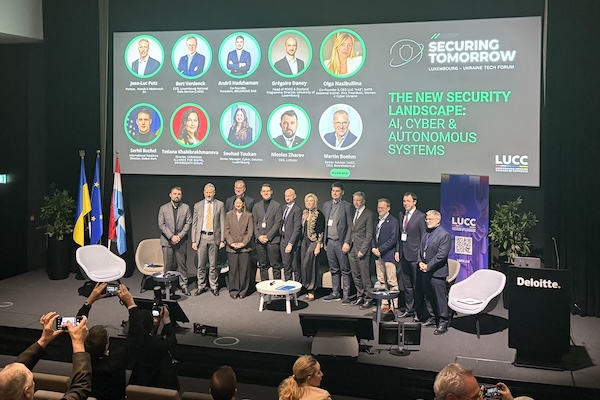
On Tuesday 17 November 2026, the Luxembourg-Ukraine Chamber of Commerce (LUCC) held the Luxembourg-Ukraine Tech Forum 2026: Securing Tomorrow at Deloitte's premises in Luxembourg-Gasperich.
The event brought together approximately 80 participants, including representatives of government, industry, technology companies, research institutions and the investment sector, to explore the innovations, partnerships and investments shaping Europe's future security capabilities. Discussions focused on the evolving security landscape, including artificial intelligence (AI), cyber defence and autonomous systems, as well as innovation and investment in future capabilities, critical infrastructure protection, space technologies and digital resilience.
In her opening speech, Evgenia Paliy, President of the LUCC, highlighted the role of technology in Ukraine amid the ongoing war, describing how drones are being used to deliver food and ground robots to evacuate wounded people from dangerous frontline areas. She emphasised the difference between how technology is perceived in Europe and Ukraine, stating: "In Europe, in Luxembourg, we discuss technologies as innovation, as securing tomorrow, as something of tomorrow. Technologies in Ukraine is about today, it is about survival, it is about living of everyone." Evgenia Paliy also stressed the importance of learning from Ukraine's experience and developing practical cooperation, rather than focusing solely on solidarity, before inviting participants to observe a minute of silence in memory of those who had lost their lives.
Dennis Werneus, Deputy Head of the European Commission Representation in Luxembourg, continued the opening session, stating: "Ukraine is not a distance crisis. It is not a faraway conflict. It is a war on European soil, against Ukraine, and against democracy and freedom as we know it." He highlighted how Russia's war against Ukraine had demonstrated the growing importance of artificial intelligence, cyber defence, autonomous systems and space-based technologies for Europe's security. Dennis Werneus also underlined the EU's continued support for Ukraine and Luxembourg's potential contribution through its expertise in space, cybersecurity and financial services, emphasising the role of the country's financial centre in mobilising investment for Ukraine's resilience and reconstruction.
The new security landscape: AI, cyber and autonomous systems
The first panel discussion, "The New Security Landscape: AI, Cyber & Autonomous Systems", brought together experts from Luxembourg and Ukraine to examine cybersecurity, artificial intelligence and autonomous technologies. Martin Boehm, Senior Advisor at LUCC and CEO of Boardtalent.ai, moderated the discussion.
Tetyana Khabibrakhmanova, Director of the Ukrainian Alliance for Digital Sovereignty (DSUA), highlighted the importance of protecting national digital infrastructure amid Russia's ongoing attacks on Ukraine. She explained that Ukraine had initially moved critical data abroad but subsequently recognised the risks of dependence on foreign infrastructure. To strengthen resilience, Ukrainian providers have focused on decentralising data centres, maintaining backups and ensuring that essential services remain operational even when facilities come under attack. She stressed that protecting digital infrastructure, which supports banks, hospitals and other everyday services, is a matter of national security and digital sovereignty.
Souhad Toukan, Senior Manager, Cyber at Deloitte Luxembourg, drew parallels between the financial and defence sectors, highlighting lessons from the EU's Digital Operational Resilience Act (DORA). She identified three priorities for strengthening resilience: understanding supply chain dependencies, assessing the risks of relying on a limited number of technology providers and integrating governance from the outset. Referring to the importance of supply chain security, she warned: "You're only as resilient as the weakest element within the supply chain." She added that while such vulnerabilities could lead to financial losses and regulatory sanctions in the financial sector, they could pose risks to national security in the defence sector.
Jean-Luc Putz, Partner at Arendt & Medernach, addressed the legal aspects of cybersecurity, noting that cyberattacks had become a major part of his firm's business crime practice. He argued that companies could prevent many incidents through greater investment in cybersecurity measures and employee training. While regulations such as DORA, the NIS directive and the General Data Protection Regulation (GDPR) impose obligations in specific areas, he noted that broader legal requirements remained limited. Emphasising the importance of encouraging businesses to take preventive action, Jean-Luc Putz commented: "I'm more in favour in general of incentive measures, but every company should know that they have an interest in investing a lot in cybersecurity." He also highlighted the potential consequences of attacks on critical services such as hospitals.
Andrii Hadzhaman, Co-founder and President of BRUDRONE SAS, focused on the development of autonomous defence systems in Ukraine and their role in protecting military personnel. He explained how his company's priorities had evolved from developing supply solutions in 2014 to producing drones and autonomous systems following Russia's full-scale invasion in 2022. He emphasised that the main objective was not simply to improve technological performance but to reduce the risks faced by soldiers and protect critical infrastructure. Addressing the ethical implications of autonomous weapons, Andrii Hadzhaman stressed that humans must retain responsibility for decisions involving the use of lethal force.
Serhii Buchel, International Relations Director at Global Mark, discussed the development of swarm technology that allows a single operator to control multiple unmanned systems simultaneously. He explained that the company's technology currently integrates aerial and ground systems, with plans to expand into maritime operations. Highlighting Ukraine's limited human resources, Serhii Buchel noted that software could coordinate and execute tasks while operators monitored progress and intervened when necessary. He also raised the importance of maintaining human oversight as artificial intelligence increasingly supports military operations.
Nicolas Zharov, CEO of LUXUAV, highlighted the rapid transformation of drone technology during Russia's full-scale invasion of Ukraine. He described how unmanned systems had evolved from individual surveillance devices into a diverse range of platforms supporting reconnaissance, combat, logistics and rescue operations. Summarising this development, Nicolas Zharov remarked: "We no longer have a single drone revolution. We have an ecosystem of unmanned capabilities." He also pointed to the growing use of ground robots for supply and evacuation missions, stressing that combining different unmanned systems and adapting military tactics could create new operational advantages.
From an academic perspective, Grégoire Danoy, Head of PCOG and Doctoral Programme Director at the University of Luxembourg, discussed advances in swarm intelligence and the challenges of developing secure autonomous systems. He explained that researchers had moved from manually designing drone swarm behaviour to using artificial intelligence to generate coordinated responses, allowing individual drones to exchange information and adapt to their environment. Highlighting the resilience of distributed systems, he explained: "If you lose one or several items in the system, the system will self-organise and keep working." However, Grégoire Danoy also warned that ensuring the safety and trustworthiness of such systems remained a major challenge, particularly as interactions between autonomous devices could create additional vulnerabilities.
Turning to data governance, Bert Verdonck, CEO of Luxembourg National Data Service (LNDS), highlighted the importance of maintaining control over sensitive information while enabling secure exchanges between organisations. He outlined Luxembourg's approach to decentralised data management, including hybrid storage solutions and trusted data-sharing mechanisms, and cautioned against making information about critical infrastructure publicly accessible. He also stressed the need to develop artificial intelligence without concentrating control of data in the hands of a few major technology providers. Looking at Europe's opportunities in the sector, Bert Verdonck commented: "There are plenty of opportunities for all of our countries to thrive."
Olga Nasibullina, Co-founder and CEO of LLC "242" and NATO 4 Cyber Ukraine Women seasonal trainer, addressed the growing impact of artificial intelligence on cybersecurity, stressing the importance of public-private partnerships and international cooperation. She warned that AI was making cyberattacks faster, cheaper and easier to scale, but noted that the same technologies could significantly improve defensive capabilities. As an example, she explained that AI-powered penetration testing could reduce costs from several thousand euros to approximately €1,000 while shortening the process from several weeks to a single day. Emphasising the need for organisations to adapt, Olga Nasibullina urged: "We should accept and use the same tools on the defence side as attackers are using." She added that more affordable AI-powered security services could help smaller businesses strengthen their protection against cyber threats.
Innovation and investment for future capabilities
The second panel, moderated by LUCC President Evgenia Paliy, focused on protecting critical infrastructure, space technologies and investment in future security capabilities, with speakers sharing practical experiences from Ukraine and perspectives from Luxembourg's defence, technology and investment sectors.
Volodymyr Prokopiv, Deputy Head of the Kyiv City State Administration (KCSA), described the challenges of maintaining essential public services in the Ukrainian capital amid continuing Russian missile and drone attacks. He highlighted the importance of ensuring that hospitals remain operational during prolonged disruptions to electricity, water and heating, recalling an incident in which a Kyiv hospital maintained critical medical services after losing its main electricity supply. Volodymyr Prokopiv explained that the city was moving beyond individual backup generators towards integrated energy systems combining battery storage, renewable energy and smart management technologies. He also invited European cities, technology companies and investors to cooperate on projects aimed at strengthening hospital resilience, emphasising: "We are interested in not just more generators. We are looking for a comprehensive solution capable of ensuring continuity of medical care even in the most difficult circumstances."
Vasyl Ananyev, Deputy Director of Department and Head of Division at Ukraine's State Service of Special Communications and Information Protection, outlined the country's approach to protecting critical infrastructure against increasingly sophisticated attacks. He explained that his organisation coordinates national protection efforts, maintains a register of critical infrastructure and works with regional authorities and operators to assess vulnerabilities and develop security plans. Vasyl Ananyev also highlighted the growing threat to smaller, less protected facilities and the importance of understanding dependencies between essential services. Drawing on Ukraine's wartime experience, he stressed the need to identify priorities, monitor evolving threats and strengthen cooperation between authorities and infrastructure operators.
Turning to space security, Andrii Kolesnyk, Chief Specialist in the Defence Space Policy Department at Ukraine's Ministry of Defence, discussed how Russia's war had changed Ukraine's understanding of space-based services and their importance for national security. He stressed: "It has become part of a critical infrastructure." His presentation highlighted the growing importance of satellite communications, Earth observation, navigation and space situational awareness for military operations and civilian services, as well as the need to protect these systems against cyberattacks and interference.
Other speakers from Ukraine and Luxembourg contributed perspectives from the defence, space technology, cybersecurity, public administration, finance and investment sectors, discussing opportunities for technological innovation and cross-border cooperation.
The forum concluded with a networking cocktail, providing participants with an opportunity to exchange ideas, establish contacts and explore potential cooperation between Luxembourg and Ukraine.