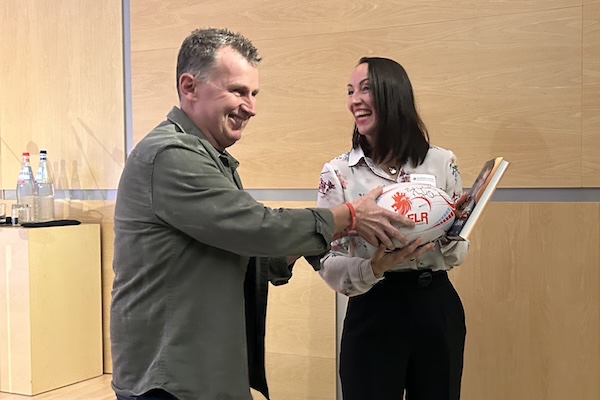
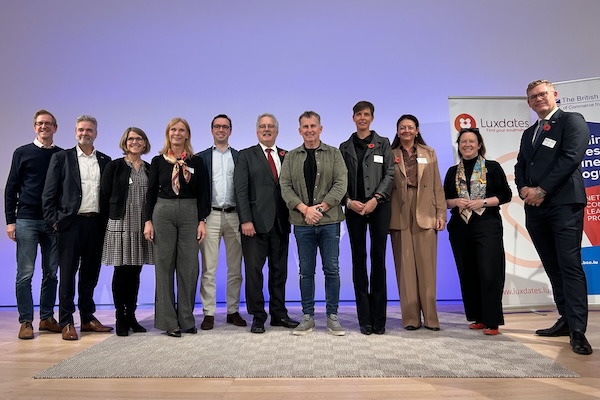
 Group photo including: Nigel Owens (centre); Joanne Olivier, British Ambassador to Luxembourg; Jean McDonald, Irish Ambassador to Luxembourg; Giulia Iannucci, President of Rugby Club Luxembourg (RCL);
Credit: Elza Osmane, Chronicle.lu
On Thursday 22 October 2026, the British Chamber of Commerce for Luxembourg (BCC) organised its annual Leadership Forum, titled "Making the Tough Calls", featuring former international rugby referee Nigel Owens as guest speaker, taking place at Banque de Luxembourg in Luxembourg-Ville.
The fully booked conference room welcomed approximately 150 attendees, including business professionals, aspiring leaders and members of Luxembourg's rugby community.
The evening began with an introduction by Giulia Iannucci, President of Rugby Club Luxembourg (RCL), who highlighted the values associated with rugby, including teamwork, respect, courage and resilience.
Andrew Notter, Chairman of the British Chamber of Commerce for Luxembourg, then welcomed the guests and introduced the evening's main theme: decision-making under pressure.
The evening's headline speaker, Nigel Owens, then took the stage, beginning with a personal account of the challenges he had faced and how overcoming them shaped his approach to leadership and decision-making.
In a candid yet humorous manner, the former rugby referee reflected on how upbringing, education, family and sport influence people's values and attitudes from an early age.
Recalling his childhood in a small, traditional village in rural West Wales during the 1970s, Nigel Owens explained that Welsh was his first language and that he did not learn English until the age of seven. His refereeing career began by chance at sixteen, although he joked that his original ambition had been to appear on the TV show Antiques Roadshow.
The talk gradually turned to more personal experiences, as Nigel Owens described the difficulties he faced coming to terms with his sexual orientation while growing up in an “old-fashioned” environment. "I thought there's no way that I can be myself. Because people can't find out. People are not going to like me," he said.
He explained that fear of rejection led him to withdraw from different social situations, affecting his personal relationships and ability to work as part of a refereeing team.
Nigel Owens spoke openly about experiencing depression, alcohol misuse, eating disorder that led to bulimia, as well as his use of steroids later on. By the age of 26, he said, his mental health had got even worse, culminating in a suicide attempt.
He went on describing how the support of his parents and the Welsh Rugby Union after helped him rebuild his confidence, leading to 100 officiated international matches, including the 2015 Rugby World Cup final.
Reflecting on his experiences, Nigel Owens emphasised the importance of accepting people for who they are. "It shouldn't matter who you are. It shouldn't matter what country you come from, what the colour of your skin is, the sexual identity or religious beliefs," he said.
Drawing parallels between the rules and values of rugby and everyday life, he stressed that leadership requires several key qualities: trust; respect; teamwork; preparation and the ability to make difficult decisions, even when they are unpopular; as well as focusing on what can be controlled rather than worrying about what cannot; accepting mistakes instead of pursuing perfection; and showing empathy while still holding people accountable for their actions.
"If you try to be perfect, then believe me, the perfect becomes the enemy of the good," he underlined.
He illustrated the importance of making unpopular decisions by recalling a 2013 match between Ireland and New Zealand in Dublin. After ordering New Zealand to retake a conversion because Irish players had charged forward too early, Nigel Owens faced boos from the crowd. New Zealand went on to win 24-22 but he stood by his decision despite the reaction.
The evening concluded with a Q&A session, with many attendees raising their hands, eager to ask questions to the former rugby referee.
Returning to the earlier example, an audience member asked how he handled criticism from large crowds. "If they're booing me, then I probably made the right decision," he laughed.
Following the discussion, attendees had an opportunity to speak further with Nigel Owens, take photos and request autographs.