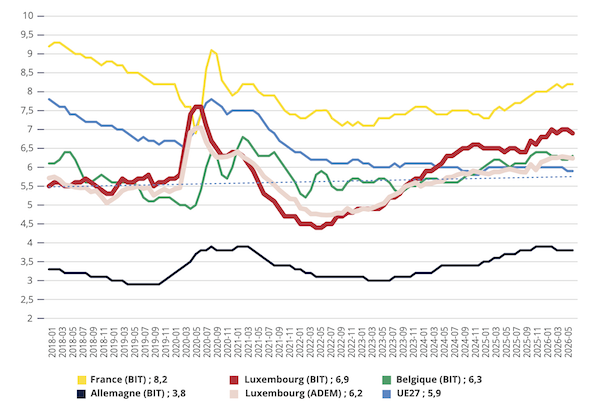
 Evolution of the monthly ADEM (Luxembourg) and ILO unemployment rates, 2018-2026 (seasonally adjusted data);
Credit: Eurostat / STATEC
Evolution of the monthly ADEM (Luxembourg) and ILO unemployment rates, 2018-2026 (seasonally adjusted data);
Credit: Eurostat / STATEC
On Tuesday 11 August 2026, Luxembourg's Chamber of Employees (Chambre des Salariés - CSL) published a new edition of its “EcoNews”, highlighting a fragile labour market, rising unemployment and a deterioration in the quality of jobs being created.
According to the CSL, Luxembourg's unemployment rate, as defined by the International Labour Organization (ILO), stood at 6.9% in May 2026, compared with an EU average of 5.9%. The rate was also higher than in Germany (3.8%) and Belgium (6.3%) but remained below that of France (8.2%). The ADEM unemployment rate in Luxembourg stood at 6.2%.
The CSL described Luxembourg's economic situation as "complex and contrasting", with economic growth not necessarily translating into employment growth. In 2025, financial and insurance activities accounted for 28% of gross value added (GVA), but only 11% of hours worked. By contrast, sectors such as commerce, transport, accommodation and food services, as well as construction, accounted for a considerably larger share of hours worked relative to their contribution to GVA.
The report further highlighted differing trends across individual sectors. While some sectors have experienced declines in both GVA and hours worked, others have recorded economic growth without a corresponding increase in employment. According to the CSL, public administration and the health and social work sector were the only sectors to see clear job growth, helping to offset job losses in other sectors.
The CSL also drew attention to changes in the profile of jobseekers. In 2025, 31% of those registered with ADEM held a higher education qualification, compared with 19% in 2018. Although unemployment among people with higher education qualifications remained lower than among other educational groups, the CSL noted a deterioration in their situation in recent years.
The report found that employment opportunities for highly qualified jobseekers appeared to be declining, particularly in knowledge-intensive sectors. The CSL described labour market pressures as remaining "localised and decreasing", affecting specific profiles and sectors rather than the economy as a whole.
The CSL raised particular concerns about the quality of new employment. According to the report, net job creation remained positive only due to fixed-term contracts (contrats à durée déterminée - CDD), with the CSL stating that "the quality of employment has undeniably declined since 2022".
More than 3,130 permanent jobs (contrats à durée indéterminée - CDI) were lost in Luxembourg in 2025. The decline was particularly pronounced in commerce and motor vehicle repair, as well as construction, which each recorded more than 1,000 permanent jobs lost within one year.
According to the CSL, the predominance of fixed-term contracts may lead to more frequent transitions between employment and unemployment and consequently contribute to rising unemployment. The organisation also highlighted an increase in long-term unemployment between 2024 and 2025, particularly among higher education graduates. It described net job creation as "very weak and insufficiently sustainable".
In response to these developments, the CSL said that "strengthened collaboration between labour market stakeholders" appeared essential. It suggested that the tripartite monitoring committee foreseen in the June 2026 agreement could consider establishing sector-specific redeployment and retraining units in sectors facing crises, restructuring or significant job losses.
Such units could support employees in retraining and moving towards sectors that are recruiting. The CSL also highlighted the importance of anticipating future skills requirements in consultation with staff delegations.
The CSL also called for a closer examination of the reasons behind persistent labour shortages in certain occupations. These could include a lack of appropriately trained workers, skills mismatches or "unattractive working conditions" related to working hours, workload, pay, contract type or mobility. It also stressed the need to anticipate future labour requirements in sectors with an ageing workforce, including industry, construction, transport and warehousing.