 Employment and Unemployment in Luxembourg;
Credit: STATEC
Employment and Unemployment in Luxembourg;
Credit: STATEC
On Tuesday 21 July 2026, Luxembourg's national statistics institute, STATEC, published its latest Conjoncture Flash report, reporting stronger employment growth despite rising unemployment, while also highlighting developments in inflation, wages, housing and lending conditions.
Employment growth continues but unemployment also rises
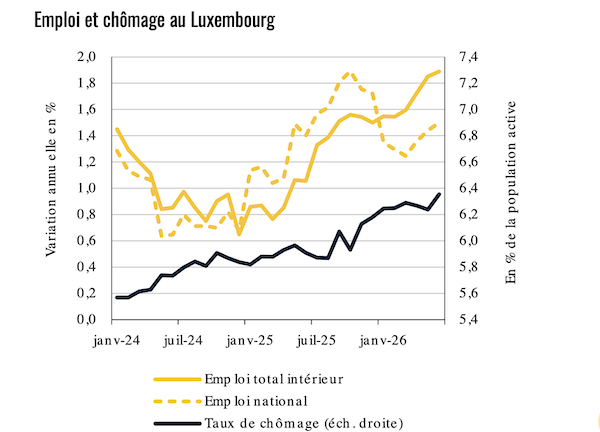
According to preliminary data available up to June 2026, employment is expected to increase by 0.5% in the second quarter, continuing the recovery that began at the end of 2024. Annual employment growth reached 1.9% in June, well above the 0.6% recorded in December 2024, although it remained below the annual increases of more than 3% seen in 2022 and before the COVID-19 crisis.
Despite this stronger employment growth, Luxembourg's unemployment rate increased to 6.4% of the labour force in June, compared with 5.9% in August 2025. STATEC attributed this to relatively weak resident employment growth and an expanding labour force, potentially linked to more previously inactive people registering with ADEM.
Cross-border workers drive job growth
The report noted that the labour market recovery continues to benefit cross-border workers more than residents. Cross-border employment rose by 2.4% year-on-year in June, mainly driven by recruitment in the health and social care sector, as well as administrative and support services.
Meanwhile, resident employment remained weaker in several sectors, including construction, retail, hospitality, industry and information and communication. The opposite trend was observed in financial and insurance activities, where resident employment increased while non-resident employment declined, continuing a trend seen over the past decade.
French commuters accounted for around 90% of the increase in cross-border employment between December 2025 and April 2026. Belgian cross-border workers also recorded growth, while German commuters returned to positive growth, particularly in health and social care, after two years of decline.
Recruitment prospects weaken
STATEC noted that if employment maintains its current pace throughout the rest of the year, annual employment growth could slightly exceed its forecast of 1.7% for 2026.
However, business surveys indicate that recruitment expectations have weakened across all sectors in recent months. In addition, the number of vacancies reported to ADEM declined by almost 7% in the second quarter of 2026, following a 4% increase in the previous quarter.
Service inflation remains moderate
Service inflation increased from 1.3% in May to 2.4% in June following the June 2026 wage indexation. Nevertheless, STATEC noted that it remained below both the 2024 average and the euro area average.
Restaurants, cafés and similar establishments remained the largest contributors to service inflation, followed by care homes, housing maintenance and repair services, higher education fees, residential rents and package holidays.
Labour costs slow
The average labour cost per employee increased by 3.7% year-on-year during the first quarter of 2026, down from 4.1% in the previous quarter.
According to STATEC, the slowdown mainly reflected weaker growth in base salaries, particularly in the public sector. At the same time, higher employer pension contributions and stronger wage growth in scientific and technical activities continued to support labour costs.
Housing market shows signs of recovery
Residential property prices increased by 1.7% year-on-year during the first quarter of 2026, broadly in line with inflation but below wage growth. The number of property transactions also rose by 3.3%, although sales of newly built apartments remained well below pre-crisis levels.
STATEC also noted that changes to its property price index methodology had only a limited impact on the overall index but affected certain market segments. Once this methodological effect is removed, apartment prices appeared broadly stable between the fourth quarter of 2025 and the first quarter of 2026, while house prices increased by 2.4% over the quarter.
Borrowing costs continue to rise
Interest rates on almost all new bank loans increased during the first five months of 2026, with the exception of variable-rate mortgages.
Consumer loan rates reached 5%, their highest level since mid-2024, while fixed-rate mortgage rates climbed to 3.9%. Variable mortgage rates remained around 3.1% but are expected to rise following the European Central Bank's latest interest rate increase.
STATEC also reported that banks had tightened lending conditions, with demand for new loans expected to decline further in the coming months.