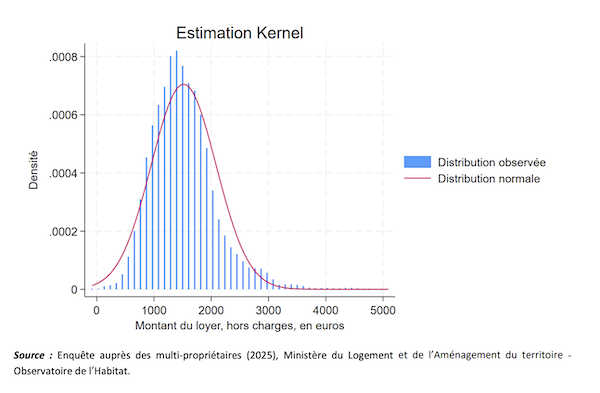
 Distribution of Monthly Residential Rents in Luxembourg;
Credit: Housing Observatory / Ministry of Housing and Spatial Planning
Distribution of Monthly Residential Rents in Luxembourg;
Credit: Housing Observatory / Ministry of Housing and Spatial Planning
On Friday 5 June 2026, Luxembourg's Housing Observatory (Observatoire de l'habitat), under the supervision of the Ministry of Housing and Spatial Planning, published Analytical Report No. 24, presenting the first results of the country's "rent cadastre" survey.
According to the report, the survey was conducted in October and November 2025 among nearly 28,000 multiple-property owners. With 5,799 respondents, including 5,116 complete questionnaires, it represents the first large-scale source of information on rents actually paid by tenants during ongoing leases in Luxembourg.
Until now, analyses of the rental market primarily relied on advertised rents for newly available properties. The new report provides insights into rents paid by existing tenants and offers a clearer picture of the factors shaping Luxembourg's rental market.
The report revealed significant variation in rental prices. Apartments accounted for 86% of the dwellings surveyed, with more than half (55.3%) of rents ranging between €1,000 and €1,750 per month. At the same time, 16.4% of properties recorded monthly rents above €2,000.
The territorial analysis confirmed substantial regional differences. Luxembourg City recorded the highest median rent level at €25.56 per square metre, ahead of the rest of Luxembourg canton and Esch-sur-Alzette canton. The eastern and northern cantons reported considerably lower rents.
The report also identified the tenant's move-in date as one of the main factors explaining rent disparities. According to the analysis, rents for leases signed in 2024 or 2025 were nearly 75% higher than those for properties occupied before 2010, illustrating the impact of continuous rent increases over the past fifteen years.
According to the Housing Observatory, these findings highlight a strong "temporal stratification" of the rental market, where older leases coexist with rents reflecting current market conditions. The report notes that this has important implications for housing affordability, access to accommodation and the interpretation of rental market indicators.
Alongside Analytical Report No. 24, the Housing Observatory published two additional studies. Note No. 47 examined methods for identifying so-called "café rooms" and other forms of informal furnished-room rentals, which are often associated with affordable housing shortages and may, in some cases, raise concerns regarding habitability, safety and sanitary conditions. The exploratory study concluded that fieldwork remains the most effective method for identifying such accommodation and called for stronger cooperation between municipalities and national authorities to improve knowledge of this segment of the housing market.
Another study, Note No. 48, presented a comparative analysis of rent-control regulations across the European Union. The study found that while limits on rent increases during tenancy are relatively widespread, controls on initial rents are less common and vary significantly between countries. The report also highlighted the importance of enforcement mechanisms and warned that extensive exemptions may reduce the effectiveness of rent-control measures.
The full reports (in French) are available on logement.lu: Analytical Report No. 24, Note No. 47 and Note No. 48.