 New signatories;
Credit: IMS Luxembourg
New signatories;
Credit: IMS Luxembourg
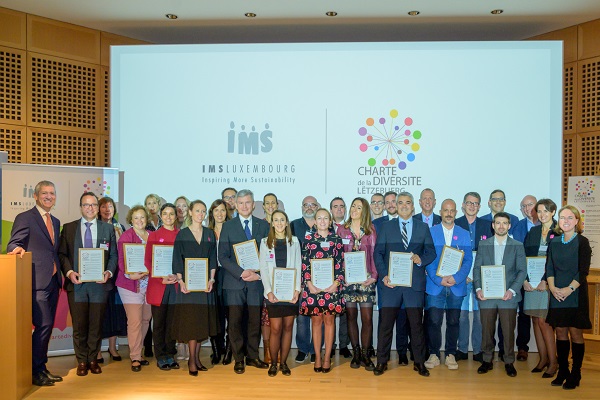
The ninth official signing session of the Lëtzebuerg Diversity Charter, held yesterday evening at the Mudam, saw 23 new organisations join the national movement for the promotion and management of diversity in Luxembourg.
Each year since the launch of the Lëtzebuerg Diversity Charter in 2012, a signing session brings together new organisations wishing to officially commit to diversity. This year's session was opened by Luxembourg's Minister for Family Affairs and Integration, Corinne Cahen, who is also the patron of the Diversity Charter.
On this occasion, 23 organisations chose to publicly show their willingness to value and manage diversity, bringing the number to a total of 188 signatories. The new signatories are:
- Arendt & Medernach
- Armacell International S.A.
- Banque Havilland
- CapFields
- Clifford Chance
- Crèche Les P’tits Bouchons
- Ebos Luxembourg
- Fédération Copas
- Fidelity International
- fr2s
- Groupe Nouvelles Perspectives
- Hines Luxembourg Sàrl
- JAMENDO
- John Deere Bank SA
- L.S.C. Engineering Group
- LSRS
- Luxnetwork
- Maltem Consulting
- Minusines S.A.
- PGIM Real Estate Luxembourg S.A.
- Schroeder & Associés
- SuperDrecksKëscht – Oeko Service Luxembourg SA
- TNP Luxembourg
The event also saw IMS Luxembourg, the national coordinator of the Diversity Charter, present its new website www.chartediversite.lu. The site presents all the signatories’ best practices regarding diversity management since 2012.
The signing session was followed by IMS Luxembourg's annual conference. This year's topic was "Managing language diversity for inclusion". On this occasion, guest speaker Hélène Langinier discussed the impact of language diversity and to find out how to value it within organisations. Hélène is a professor at the EM Strasbourg Business School who specialises in language diversity research.
In order to best value multilingualism within a company, Hélène highlighted the need to define a language policy and to encourage innovative language practices, such as "translanguaging" (combining several languages in one and the same sentence or even creating new words), as well as offering tandem projects and the development of employees’ intercultural skills.