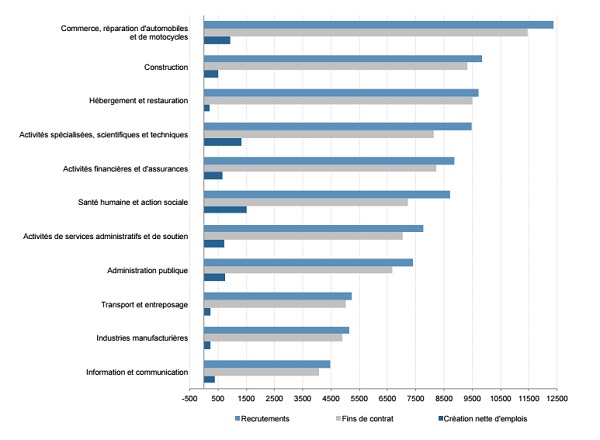
The Réseau d'étude sur le marché du travail et de l'emploi (RETEL) has published its fourth dashboard on employment, outlining labour flows over the last year in order to provide an analysis of the Luxembourg labour market from March 2014 until March 2015.
During this period, more than 124,000 recruits and 114,500 contract terminations were observed, showing a 1.8% increase compared with the period from December 2013 to December 2014 for each.
Each dashboard provides a new employment indicator, with the new indicator for the latest study being the nature of the contract, whether this is permanent or temporary. With all sectors considered, neraly 30% of recruitments carried out between March 2014 and March 2015 were fixed-term contracts (CDD), whilst more than 70% corresponded to permanent contracts (CDI). Among the new hires with fixed-term contracts, nearly three quarters were for up to six months, whilst only 5% of CDD were signed for a period exceeding twelve months.
On March 2015, there were 382,751 employees in Luxembourg against 373,371 for the same day in 2014. Between these two dates, there were 124,077 recruitments and 114,697 contract terminations, of which 5,454 were related to retirement. Paid employment increased by 9,380 units over the period studied, marking an increase of 2.5%.
Temporary work accounted for around one fifth of changes observed in the market. Of all recruitments made, 19% were for temporary work whilst 81% were for non-temporary jobs. 21% of contract terminations were related to temporary paid employments and 79% for non-temporary work. Amongst all employees working in Luxembourg, 2% are in temporary employment.
In the trade sector, the number of recruitments exceeded the number of contract terminations, indicating a net creation of jobs. This was observed in all sectors examined. The areas of trade, construction and accommodation and food services represented the sectors which created the most employment between March 2014 and March 2015, with 12,400, 9,800 and 9,700 recruitments respectively. It was also in these same sectors that the greatest number of contract terminations were observed.
Amongst the 99,983 recruits, excluding temporary ones, carried out between March 2014 and March 2015, 47,332 or 47.3% were women, against 52,651 male recruitments, or 52.7%. In all sectors, almost one recruitment in two was therefore attributed to a woman. The figures were similar for contract terminations, at 43,124 or 47.4% for women compared to 47,822 or 52.6% for men.
The sectors found to recruit the most women were that of health and social action, constituting 13.4% of female recruits excluding temporary work. Far less men were hired in these sectors, at only 4.5%. Administrative and support services, including cleaning companies, also showed a disparity between male and female recruitments, representing 10.9% new female employees against 4.9% male. HORECA, or the food and beverages sector, represented 11.1% of female recruitments against 8.5% male recruitments. However, for other sectors the contribution to female and male recruitment was found relatively similar, as in the case of the financial sector which represents about 9% of both male and female recruitment.
Photo by RETEL