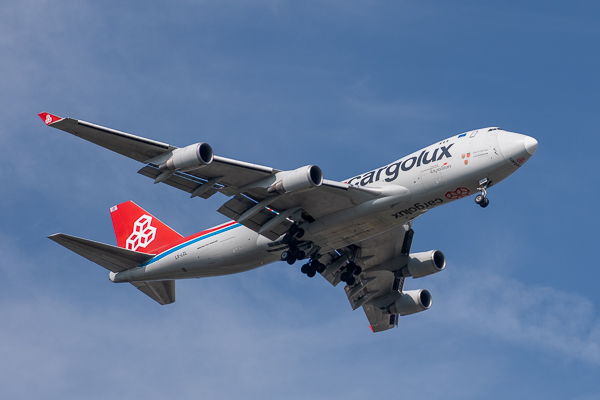
 Cargolux aircraft;
Credit: Ali Sahib, Chronicle.lu
Cargolux aircraft;
Credit: Ali Sahib, Chronicle.lu
On Wednesday 29 April 2026, the Cargolux Group (Cargolux), an all-cargo airline, held a press conference at the company’s premises in Sandweiler to present its 2025 financial and operational results, which it described as “positive”.
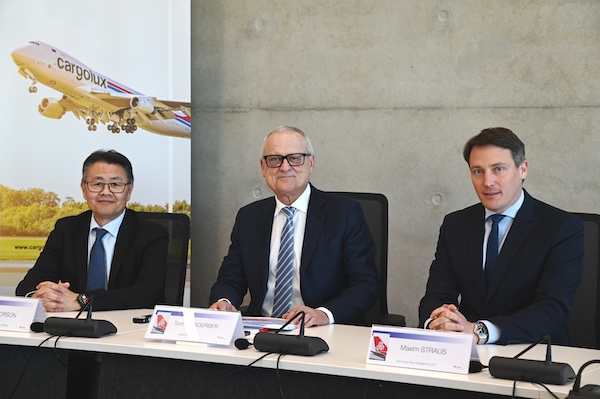
The company was represented by Richard Forson, President and CEO of Cargolux; Tom Weisgerber, Chairman of the Board; and Maxim Straus, Chief Financial Officer, who presented the financial results and answered questions from the media.
The airline reported that despite a tense and volatile market, in 2025 it generated revenues of €3,133 million and a profit after tax of €428 million.
“The past year marked a milestone for the airline as we celebrated 55 years of business in a demanding and highly complex industry. The results we achieved this year not only reflect the hard work delivered in 2025, they highlight the legacy of dedication to high standards and passion that are at the core of Cargolux’s DNA,” said Richard Forson, President and Chief Executive Officer (CEO) of Cargolux.
The results showed that the air cargo sector faced significant challenges in 2025, driven by geopolitical tensions, trade frictions and restricted airspace linked to conflicts in the Middle East and Ukraine. While sustained e-commerce activity and niche segments supported demand, these conditions placed increasing pressure on global logistics networks.
Cargolux representatives said that the company adjusted to fluctuating demand by optimising its network, including charter operations, which supported operational performance and “positive” financial results. They added that the year highlighted both “the fragility and adaptability of the industry amid shifting trade routes and geopolitical developments”.
According to the data, Cargolux ranked tenth in the International Air Transport Association (IATA) top 20 cargo carriers by international scheduled freight tonne kilometres. In 2025, it recorded 149,269 block hours and 21,789 flight cycles, with an average aircraft utilisation of 13:37 block hours per day. The load factor (FTK/ATK) stood at 65.0%, while total tonnes sold reached 1,092,731.
While last year’s data showed that growth was largely driven by strong cross-border e-commerce flows and high demand on Asia routes, the latest results point to continued pressure from geopolitical tensions and shifting trade conditions.
Looking ahead, Cargolux representatives said that possible risks include geopolitical tensions, tariff developments and supply chain disruptions, which can affect major air corridors, trade routes and customer confidence.
The escalation of the conflict in the Middle East has already affected operations, increasing jet fuel prices to historic levels and raising the risk of supply shortages.
The sustained growth of e-commerce volumes, which has supported air cargo demand, remains uncertain. At the same time, geopolitical and regulatory developments, including tariff measures and handling fees on low-value e-commerce parcels, are expected to affect international trade.
Speaking with Chronicle.lu, Richard Forson said the situation in the Middle East is not expected to directly change operations at Cargolux but requires careful planning. “We have to look at different scenarios and put contingency plans in place if the situation continues longer than anticipated,” he said.
He stressed that fuel supply remains a key concern, noting: “If the Strait of Hormuz continues to be closed for the next three months, you’re going to have quite a significant impact on a global basis. The cost of energy will increase significantly, and when transport costs go up, the cost of all goods being consumed goes up.”
Photo Caption: Richard Forson; Tom Weisgerber; Maxim Straus
Photo Credit: Cargolux