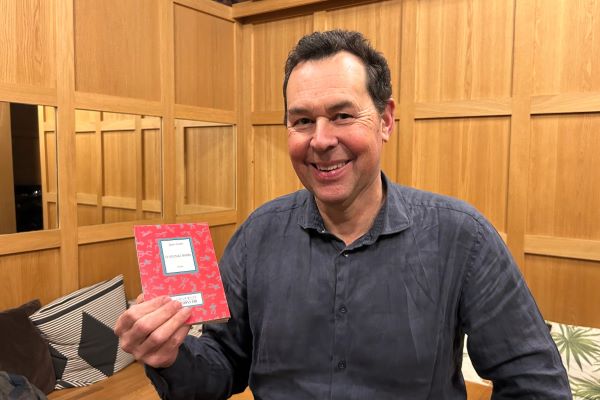
 James Leader holding a copy of In Steinsel Woods;
Credit: Elza Osmane, Chronicle.lu
James Leader holding a copy of In Steinsel Woods;
Credit: Elza Osmane, Chronicle.lu
On Thursday 22 January 2026, writer James Leader held a presentation and a scripture discussion of his recent work In Steinsel Woods at Mezza Restaurant in Luxembourg-Ville.
The event focused on the themes and narrative context of his new publication, which was published in November 2025. Alongside the new book, the author also presented his 2025 bestseller novel Into Babel, which achieved high sales and critical attention in Luxembourg.
Before presenting his work, James Leader handed out printed A4 copies of selected texts to the fifteen people in attendance, explaining that the texts are meant to be experienced not only through listening but also through reading.
Sat among the audience, the author invited the attendees to actively engage during the readings, so they accepted his suggestion and fuelled discussions by asking questions and offering comments after each poem. Rather than holding the spotlight alone, the evening developed into a shared debate amongst friends.
Before each poem, the author offered brief introductions, clarifying foreign terms, locations and personal references, as well as explaining the specific moments in his life when he wrote each piece.
He started with the poem named Fernweh, from his new book, explaining that the German term “fernweh” means “the desire not to be where you are”.
Several poems touched on personal themes such as family, religious beliefs, romance and everyday life, while others focused on life in Luxembourg, with the municipality of Steinsel being a recurring reference linked to the book’s title.
The poem In Steinsel Bakery, which opens with “What if ‘god’ were also a verb, not just a noun: If the new-green beech trees ‘god’ in April, if you ‘godded’ last night in me…”, revealed James Leader’s spiritual perspective, in which he reimagines God as an action or energy that flows through nature and human connection.
Participants eagerly stepped into the texts to contribute their interpretations and personal perspectives, commenting on the author’s word choices, expressions and even suggesting linguistic corrections.
The programme concluded with the poem In Steinsel Woods, which shares its title with the book. James Leader noted that it was the poem which inspired the name of the collection and he described the text as an expression of his fascination with nature, which he referred to as the “Great Mother”.
When asked about his writing process, the author explained that he starts from an initial impulse without knowing where it will lead. He then goes for a run in the Steinsel woods, which helps to clear his mind and to shape the final form of the text.
The evening concluded with a book signing, during which James Leader sold and signed copies for those interested and continued with informal conversations.