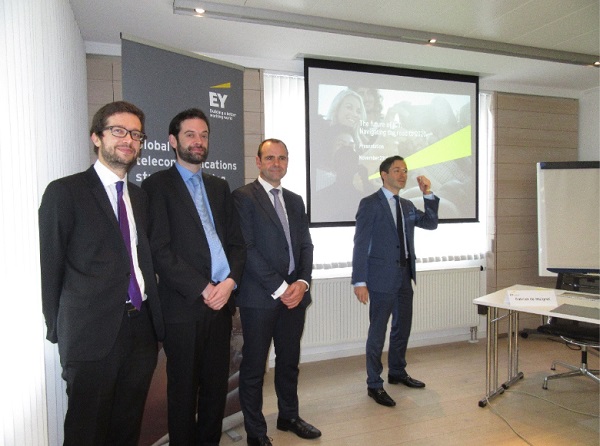
At an event held in EY's Munsbach offices under the title of 'Global Telecommunications Study: Navigating the Road to 2020', the professional services firm presented the findings of a report which sought to understand the challenges and the directions faced by the world’s major telecoms suppliers in light of rapidly changing market conditions and consumer expectations.
The study, produced from EY's office in London, placed particular emphasis on the views of key players from 40 organisations who represent about one third of the world’s top telco providers spread across all the traditionally inhabited continents. Findings arose from in depth interviews with these participants, and others from industry and technology experts backed up with research, analysis and insights from EY’s own sector professionals.
The key findings of the study should perhaps not come as too much of a surprise. The explosion of telecom innovations over the last decade has seen faster and more reliable and far reaching connectivity, while at the same time the humble mobile phone has been transformed, in the guise of the smart phone, into the world’s most widely used computing platforms.
At the same time regulators have opened up competition so that new, niche, value added suppliers can provide services over the top of the traditional telecom backbone, (OTT providers), which erode the margins of the established players by taking away business and reducing customer brand loyalty.
Voice usage is in decline, Internet TV subscriptions are growing exponentially, network investment continues to be a huge burden and prices are being pushed relentlessly downwards by competititors and regulators alike. In comparison to the established telcos, the OTTs have the advantage of being relatively nimble, being able to anticipate and drive new trends and respond to market shifts far more rapidly than their more mature and larger rivals.
Thus, according to the survey, the top concerns expressed by the survey participants are:
1) Disruptive competition (particularly OTT app providers and device manufacturers)
2) Regulatory uncertainty
3) Lack of organisational agility
4) Lack of return on investment
5) Changing customer needs and attitudes
Respondents placed a strong emphasis on the customer, with a recognition that the current environment no longer allows an operator to expect a long term client relationship. Profit from the customer therefore has to be gained over a much shorter time frame. Overwhelmingly Customer Experience Management was cited as the number 1 priority in the strategic agenda of the telcos.
In terms of the next 5 years, the biggest area of anticipated growth was found to be in digital services, with nearly a quarter of the respondents expecting that over 25% of their revenue will come from digital by 2020. The main sources of digital revenue were seen to be TV and video services, advertising marketing and e-commerce, and mobile financial services.
Summarising, Adrian Baschnonga, EY’s London based Global Telecoms Lead Analyst commented, “Customer experience is at the heart of all strategic decision making. Companies won’t see return on investment, however, until they understand their customer and value proposition”.
“Growth in the telecom and media industry in Luxembourg has been outstanding over the past decade (over 7 % a year since 2007) when major OTTs, e-commerce giants and network capacity providers have set up their European hub in the country," added Olivier Lemaire, Telecommunisations Media and Technology Leader at EY Luxembourg, who was able to offer a local perspective. "At the same time, Luxembourg succeeded in creating a dynamic environment for ICT niches startup implementation [...] In such a rapidly widening digital ecosystem, Luxembourg companies will continue to evolve and re-think their business models to take part in the digital revolution over the next decade."
Overall then, the challenges and opportunities faced over the last decade show no sign of letting up over the next 5 years, which, from a consumer perspective, can only be a good thing.
Photo by John Chalmers (L-R: Gabriel de Maigret, Adrian Baschnonga, Olivier Lemaire, Brice Lecoustey)